

MDH
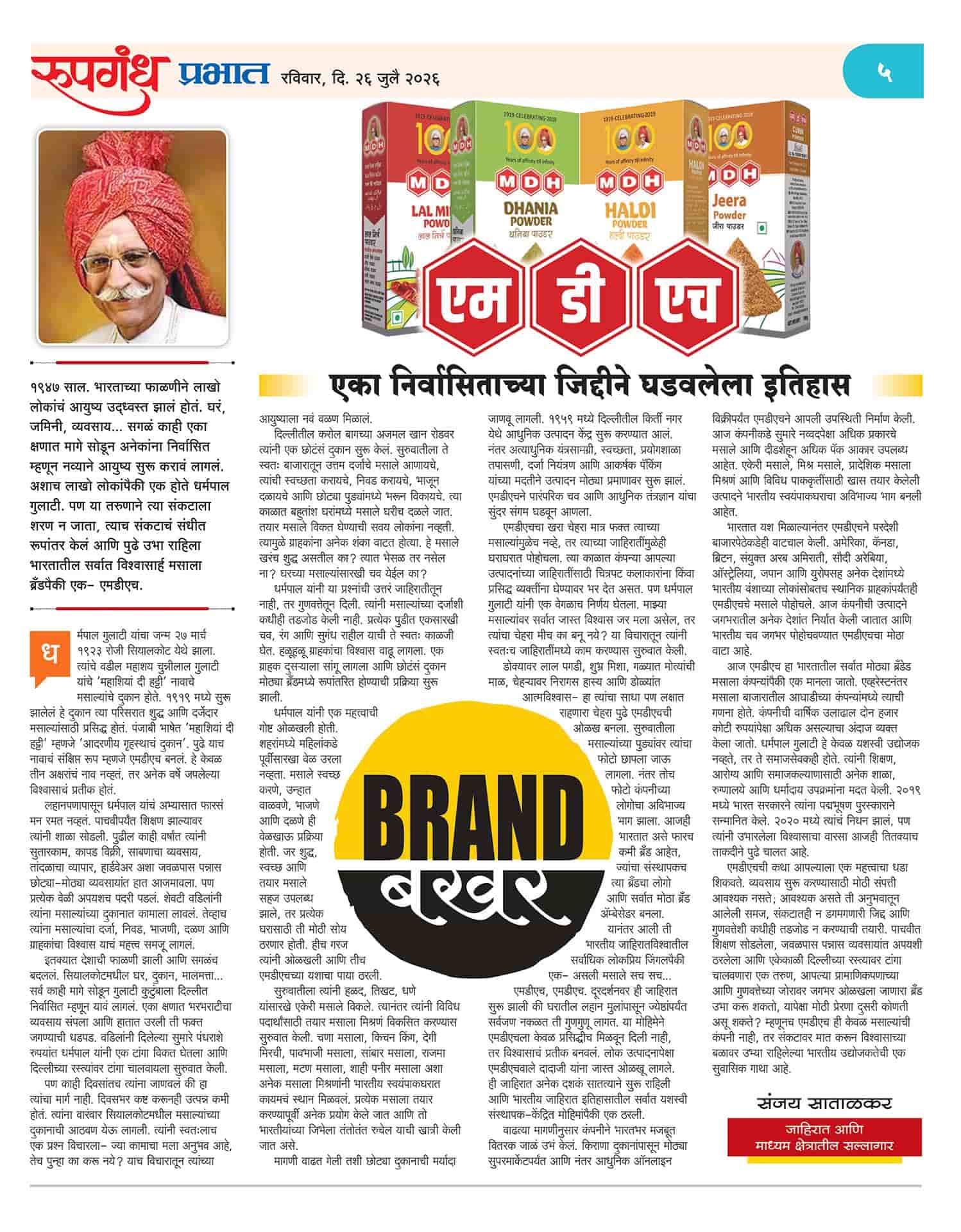
MDH – The Inspiring Story of a Refugee Who Built a Trusted Brand
In 1947, the partition of India changed millions of lives forever. People lost their homes, land, businesses, and everything they owned. Many had to start life again as refugees.
One of them was Dharampal Gulati. Instead of giving up, he turned this difficult situation into an opportunity and built one of India’s most trusted spice brands—MDH.
Dharampal Gulati was born on 27 March 1923 in Sialkot (now in Pakistan). His father, Mahashay Chunni Lal Gulati, owned a spice shop called Mahashian Di Hatti, started in 1919. The shop was famous for selling pure, high-quality spices. In Punjabi, “Mahashian Di Hatti” means “The Shop of a Respected Gentleman.” Later, this long name was shortened to MDH, which became a symbol of quality and trust.
As a child, Dharampal was not interested in studies. He left school after the fifth standard. Over the next few years, he tried nearly fifty different businesses, including carpentry, cloth trading, soap making, rice trading, and hardware. Unfortunately, every business failed.
Finally, his father asked him to work in the family spice business. There, he learned how to select good-quality spices, clean them, roast them, grind them, and most importantly, earn the trust of customers.
Then came the partition of India. The Gulati family had to leave everything behind in Sialkot and move to Delhi as refugees. Their successful business was gone overnight.
With about ₹1,500 given by his father, Dharampal bought a horse cart (tonga) and started carrying passengers on the streets of Delhi.
After a few days, he realized this was not the life he wanted. Even after working hard all day, he earned very little. He kept thinking about the spice business he knew so well.
He asked himself, “Why not start the work I already know?”
That one decision changed his life.
He opened a small spice shop on Ajmal Khan Road in Karol Bagh, Delhi. In the beginning, he personally bought the best spices from the market, cleaned them, sorted them, roasted them, ground them, packed them into small packets, and sold them.
At that time, most Indian families prepared spices at home. Ready-made spice powders were not common. Naturally, customers had many questions:
- Are these spices really pure?
- Are they free from adulteration?
- Will they taste like homemade spices?
Dharampal answered these questions not through advertisements but through quality. He never compromised on the quality of his products. Every packet had the same taste, colour, and aroma.
Slowly, customers began to trust him. One satisfied customer recommended him to another, and the small shop gradually grew into a well-known brand.
He also noticed an important change. Women in cities no longer had enough time to clean, dry, roast, and grind spices at home. Ready-to-use, clean, and pure spices could save them a lot of time.
He understood this need, and it became the foundation of MDH’s success.
Initially, he sold single spices like turmeric, chilli powder, and coriander powder. Later, he introduced ready spice blends for different Indian dishes, such as:
- Chana Masala
- Kitchen King
- Deggi Mirch
- Pav Bhaji Masala
- Sambar Masala
- Rajma Masala
- Mutton Masala
- Shahi Paneer Masala
Each spice blend was developed after many trials to ensure it matched the taste preferred by Indian families.
As demand increased, the small shop was no longer enough.
In 1959, MDH set up a modern manufacturing unit at Kirti Nagar, Delhi. Over time, the company invested in advanced machinery, hygiene, laboratory testing, strict quality control, and attractive packaging. It successfully combined traditional Indian taste with modern technology.
MDH became famous not only because of its spices but also because of its unique advertising.
During those days, most companies hired movie stars to promote their products. Dharampal Gulati chose a different path.
He believed, “If I trust my spices the most, why shouldn’t I be their face?”
He began appearing in MDH advertisements himself.
With his red turban, white moustache, pearl necklace, warm smile, and confident personality, he became the identity of the brand. His photograph first appeared on spice packets and later became a permanent part of the company logo.
Very few brands in the world have their founder as both the logo and the brand ambassador.
Another major reason for MDH’s popularity was its famous advertising jingle:
“Asli Masale Sach Sach… MDH, MDH.”
Whenever this advertisement came on television, people of all ages would sing along. The campaign made MDH not just a popular spice brand but also a symbol of trust. Many people recognised “MDH Wale Dadaji” even before they recognised the products.
This founder-led campaign became one of the most successful advertising campaigns in Indian history.
As demand grew, MDH built a strong distribution network across India. Its products reached grocery stores, supermarkets, and later online shopping platforms.
Today, MDH offers more than 90 varieties of spices in over 150 pack sizes, including single spices, blended spices, regional spice mixes, and ready-to-use cooking mixes.
After becoming successful in India, MDH expanded internationally. Its spices are now sold in countries such as the United States, Canada, the United Kingdom, the United Arab Emirates, Saudi Arabia, Australia, Japan, and many European nations.
Today, MDH is one of India’s largest branded spice companies and is considered one of the leading players in the spice market after Everest. The company’s annual turnover is estimated to be over ₹2,000 crore.
Dharampal Gulati was not only a successful businessman but also a generous philanthropist. He supported schools, hospitals, and many charitable activities.
In 2019, the Government of India honoured him with the Padma Bhushan, one of the country’s highest civilian awards.
He passed away in 2020, but the trust and values he built continue to inspire millions.
The story of MDH teaches us an important lesson:
You do not need great wealth to build a successful business. What you really need is experience, determination, honesty, and an unwavering commitment to quality.
A man who left school after the fifth standard, failed in nearly fifty businesses, and once drove a horse cart on the streets of Delhi went on to build a globally respected brand.
That is why MDH is not just a spice company. It is the inspiring story of Indian entrepreneurship, proving that with hard work, quality, and determination, even the biggest challenges can be turned into remarkable success.
Author: Sanjay Satalkar
Advertising and Marketing Consultant