

Mercedes-Benz
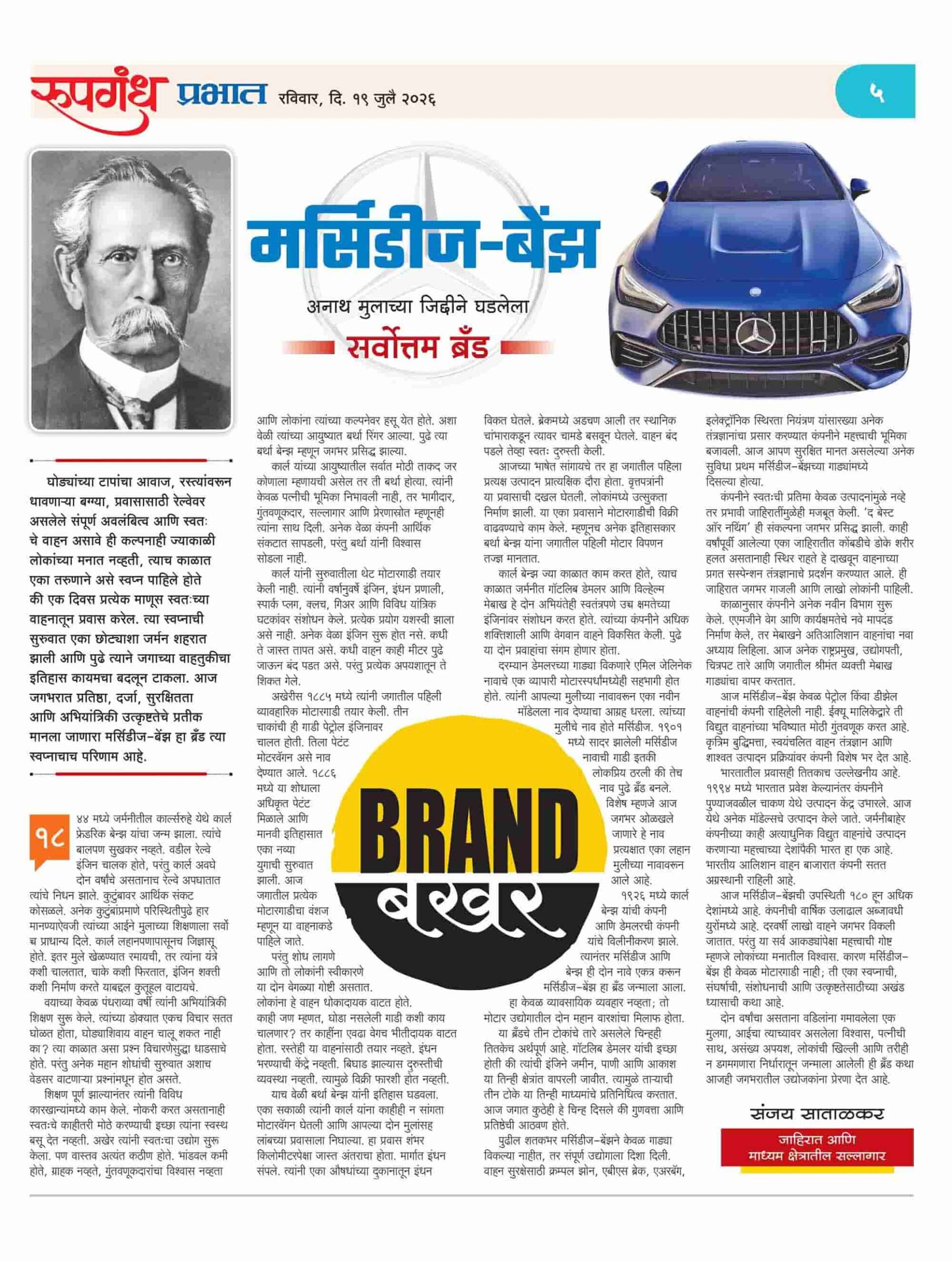
Mercedes-Benz: The World’s Most Prestigious Brand Built by the Determination of an Orphaned Boy
There was a time when the sound of horses’ hooves filled the streets, horse-drawn carriages were the primary mode of transport, people depended entirely on railways for long-distance travel, and owning a personal vehicle was beyond imagination. Yet, during that very era, a young man dreamed that one day every person would travel in their own vehicle. That dream began in a small town in Germany and eventually changed the history of transportation forever. Today, Mercedes-Benz is recognized across the world as a symbol of prestige, luxury, safety, and engineering excellence. This globally respected brand is the result of that extraordinary dream.
Karl Friedrich Benz was born in 1844 in Karlsruhe, Germany. His childhood was far from easy. His father was a railway engine driver, but when Karl was just two years old, his father lost his life in a railway accident. The family suddenly faced severe financial hardship. Unlike many families who surrender to difficult circumstances, Karl’s mother made his education her highest priority. From an early age, Karl was an extremely curious child. While other children spent their time playing, he was fascinated by machines. He constantly wondered how wheels turned, how engines generated power, and how mechanical systems worked.
At the age of just fifteen, he began studying engineering. One question occupied his mind all the time: “Can a vehicle move without a horse?” During those days, even asking such a question seemed absurd. However, many of the world’s greatest inventions have begun with questions that initially sounded impossible or even foolish.
After completing his education, Karl worked in several factories. Although he had a stable job, he was never satisfied because he always wanted to build something of his own. Finally, he started his own business. Reality, however, was much harsher than he had imagined. He had very little capital, almost no customers, investors did not believe in his ideas, and many people laughed at his vision. During this difficult phase, Bertha Ringer entered his life. She later became famous around the world as Bertha Benz.
If there was one person who became Karl’s greatest strength, it was Bertha. She was much more than a wife. She became his business partner, investor, advisor, and constant source of encouragement. She invested the money she had received as her dowry into Karl’s business. The company went through financial crises several times, but Bertha never lost faith in him or in his dream.
Karl did not build a motorcar immediately. For many years, he devoted himself to developing engines, fuel systems, spark plugs, clutches, gears, and numerous other mechanical components. Not every experiment was successful. Many times, the engine refused to start. Sometimes it overheated. At other times, the vehicle moved only a few metres before stopping. Yet, Karl treated every failure as a lesson and continued improving his designs.
Finally, in 1885, he built the world’s first practical automobile. It had three wheels and was powered by a petrol engine. He named it the Patent Motorwagen. In 1886, the invention received its official patent, marking the beginning of a completely new era in human history. Today, every modern automobile is considered a descendant of this revolutionary vehicle.
However, inventing a product and convincing people to accept it are two very different challenges. Many people considered the vehicle dangerous. Some asked, “How can a carriage move without a horse?” Others were frightened by what they considered an unbelievable speed. Roads were not designed for such vehicles. There were no fuel stations, and there were no repair facilities if the vehicle broke down. As a result, sales remained extremely low.
It was at this stage that Bertha Benz created history. One morning, without informing Karl, she took the Patent Motorwagen and set out on a long journey with their two sons. The journey covered more than one hundred kilometres. Along the way, the vehicle ran out of fuel, so she purchased fuel from a pharmacy. When the brakes developed a problem, she had leather fitted to them by a local cobbler. Whenever the vehicle stopped working, she repaired it herself.
In today’s language, this was the world’s first real product demonstration tour. Newspapers widely reported the journey, and public curiosity grew rapidly. This single journey significantly increased the popularity and sales of the motorcar. That is why many historians regard Bertha Benz as the world’s first automotive marketing expert.
While Karl Benz was working on his automobile, two other German engineers, Gottlieb Daimler and Wilhelm Maybach, were independently developing high-performance engines. Their company built more powerful and faster vehicles. Eventually, these two separate paths were destined to come together.
Meanwhile, Emil Jellinek, a businessman who sold Daimler’s cars, also participated in motor racing competitions. He insisted that one of the new models should be named after his daughter. Her name was Mercedes. The Mercedes model introduced in 1901 became so successful that the name itself eventually became the brand. Interestingly, the famous name recognized across the world today actually came from the name of a little girl.
In 1926, Karl Benz’s company merged with Daimler’s company. The names Mercedes and Benz were combined to create the brand Mercedes-Benz. This was not merely a business merger; it was the union of two great legacies in automotive history.
The famous three-pointed star logo also carries deep meaning. Gottlieb Daimler dreamed that his engines would be used on land, on water, and in the air. Therefore, the three points of the star represent these three areas of transportation. Today, wherever this emblem appears in the world, it immediately reminds people of quality, innovation, and prestige.
During the following century, Mercedes-Benz did far more than simply manufacture automobiles. The company continuously shaped the future of the automotive industry. It played a major role in introducing and popularizing several important safety technologies, including crumple zones, ABS brakes, airbags, and Electronic Stability Control (ESC). Many of the safety features that are considered standard today first appeared in Mercedes-Benz vehicles.
The company also built its reputation through memorable advertising campaigns. The slogan “The Best or Nothing” became famous across the world. One of its most celebrated advertisements showed a chicken whose head remained perfectly stable even while its body moved. This clever demonstration highlighted the advanced suspension technology used in Mercedes-Benz vehicles. The advertisement became a global sensation and was watched by millions of people.
As the company continued to grow, it introduced several specialised divisions. AMG established new standards in speed and high performance, while Maybach opened a new chapter in ultra-luxury automobiles. Today, many heads of state, leading industrialists, film stars, and some of the world’s wealthiest people choose Maybach vehicles.
Today, Mercedes-Benz is no longer only a manufacturer of petrol and diesel vehicles. Through its EQ series, the company is making significant investments in the future of electric mobility. It is also placing strong emphasis on artificial intelligence, autonomous driving technology, and sustainable manufacturing processes.
The company’s journey in India has also been remarkable. After entering the Indian market in 1994, Mercedes-Benz established its manufacturing facility at Chakan, near Pune. Today, several models are produced there. India has become one of the important countries outside Germany where some of Mercedes-Benz’s advanced electric vehicles are manufactured. The company has consistently remained one of the leaders in India’s luxury automobile market.
Today, Mercedes-Benz has a presence in more than 180 countries. The company’s annual revenue runs into billions of euros, and millions of vehicles are sold across the world every year. Yet, more important than these impressive numbers is the trust people place in the brand. Mercedes-Benz is not merely an automobile; it is the story of a dream, relentless struggle, continuous research, and an unwavering commitment to excellence.
A boy who lost his father at the age of two, a mother who believed in his potential, a wife who stood by him through every challenge, countless failures, public ridicule, and an unbreakable determination this is the story behind one of the world’s greatest brands. Even today, the journey of Mercedes-Benz continues to inspire entrepreneurs and innovators across the globe.
Author: Sanjay Satalkar
Advertising and Marketing Consultant