

Red Bull
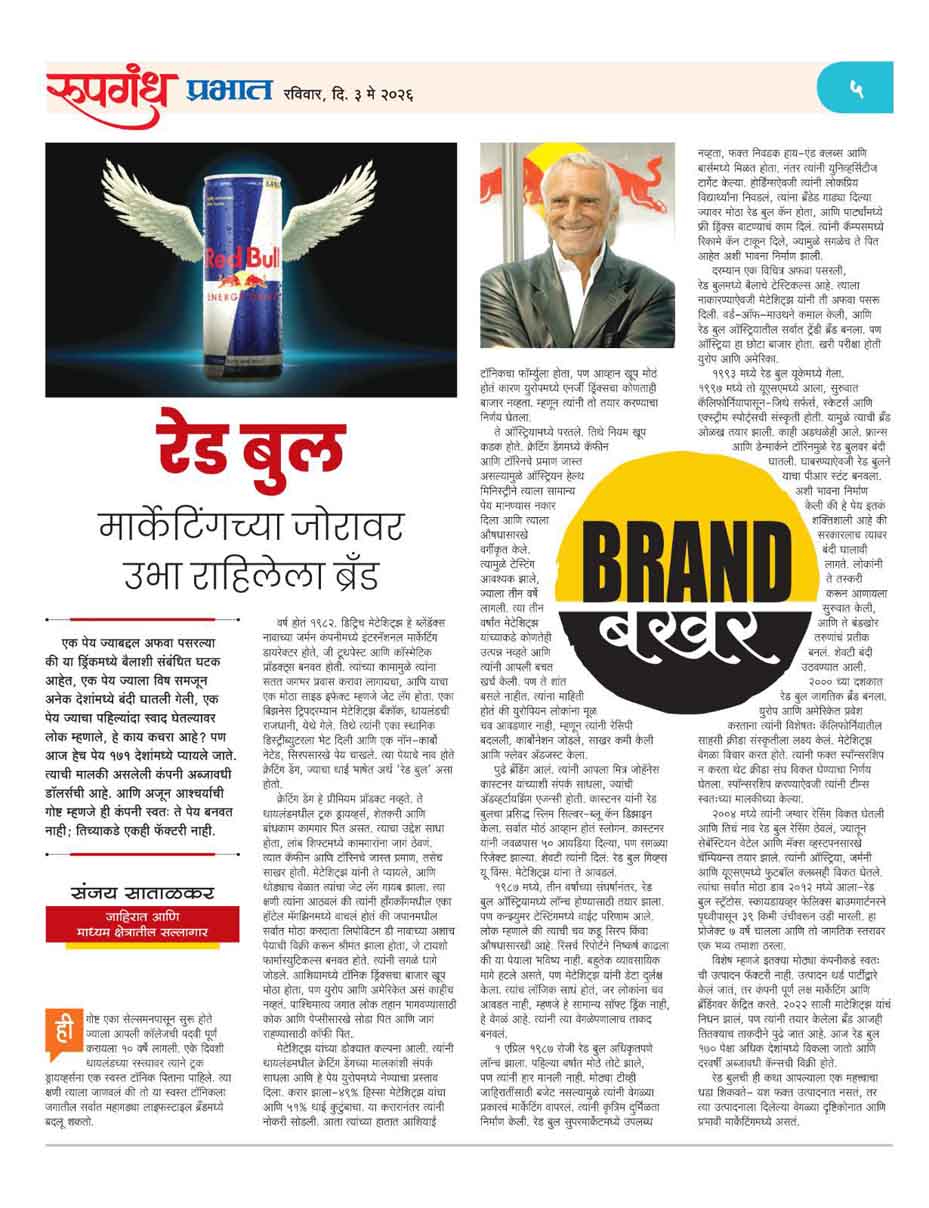
Red Bull – A Brand Built on Marketing Power
A drink surrounded by rumours people said it contained ingredients related to bulls, it was even banned in several countries as it was considered harmful, and when people first tasted it, many reacted, “What is this rubbish?” Yet today, the same drink is consumed in 171 countries. The company that owns it is worth billions of dollars. Even more surprising, the company does not manufacture the drink itself it doesn’t own a single factory.
This story begins with a salesman who took 10 years to complete his college degree. One day, on the streets of Thailand, he noticed truck drivers drinking a cheap tonic. At that moment, he realized he could turn this inexpensive tonic into one of the world’s most premium lifestyle brands.
The year was 1982. Dietrich Mateschitz was the International Marketing Director at Blendax, a German company producing toothpaste and cosmetic products. His job required constant global travel, and one major side effect was jet lag. During a business trip to Bangkok, Thailand, he visited a local distributor and tasted a non-carbonated, syrup-like drink called Krating Daeng, which means “Red Bull” in Thai.
Krating Daeng was not a premium product. It was consumed by truck drivers, farmers, and construction workers to stay awake during long shifts. It contained high levels of caffeine, taurine, and sugar. When Mateschitz drank it, his jet lag disappeared quickly. He then recalled reading in a Hong Kong hotel magazine that Japan’s top taxpayer had become wealthy by selling a similar drink called Lipovitan D, produced by Taisho Pharmaceutical.
He connected the dots. The tonic drink market was huge in Asia, but non-existent in Europe and America. In the West, people drank soda like Coke and Pepsi for refreshment and coffee to stay awake.
Mateschitz saw an opportunity. He contacted the Thai owners of Krating Daeng and proposed bringing the drink to Europe. A deal was struck 49% ownership for him and 51% for the Thai family. He quit his job. Now he had the formula, but there was a major challenge—there was no energy drink market in Europe. So, he decided to create one.
Back in Austria, strict regulations posed problems. Due to high caffeine and taurine levels, the Austrian Health Ministry refused to classify it as a regular beverage and treated it like medicine. Testing took three years. During this time, Mateschitz had no income and spent his savings. But he stayed active he knew Europeans wouldn’t like the original taste, so he modified the recipe, added carbonation, reduced sugar, and adjusted the flavour.
Next came branding. He approached his friend Johannes Kastner, an advertising expert. Kastner designed the iconic slim silver-blue can. The biggest challenge was the slogan. After rejecting nearly 50 ideas, one stood out: “Red Bull gives you wings.” Mateschitz approved it.
In 1987, after three years of struggle, Red Bull was ready to launch in Austria. However, consumer testing was negative—people said it tasted like bitter syrup or medicine. Reports concluded it had no future. Most would have backed out, but Mateschitz ignored the data. His logic was simple: if people don’t like the taste, it means this is not a regular soft drink—it’s something different. He turned that difference into strength.
On April 1, 1987, Red Bull officially launched. The first year saw heavy losses, but he persisted. Without a big advertising budget, he adopted unconventional marketing. He created artificial scarcity Red Bull wasn’t available in supermarkets, only in select high-end clubs and bars. Then he targeted universities. Instead of billboards, he selected popular students, gave them branded cars with giant Red Bull cans, and had them distribute free drinks at parties. They even placed empty cans around campuses to create the impression that everyone was drinking it.
Meanwhile, a strange rumour spread that Red Bull contained bull testicles. Instead of denying it, Mateschitz let it spread. Word-of-mouth worked brilliantly, and Red Bull became Austria’s trendiest brand.
But Austria was a small market. The real test was Europe and the US.
In 1993, Red Bull entered the UK. In 1997, it launched in the US, starting with California home to surfers, skaters, and extreme sports culture. This shaped its brand identity. There were obstacles too France and Denmark banned it due to taurine. Instead of panicking, Red Bull turned it into a PR stunt, creating the perception that the drink was so powerful that governments had to ban it. People began smuggling it, and it became a symbol of rebellion. Eventually, the bans were lifted.
By the 2000s, Red Bull became a global brand. Instead of just sponsoring sports, Mateschitz took a bold approach—he started owning teams.
In 2004, he bought Jaguar Racing and renamed it Red Bull Racing, producing champions like Sebastian Vettel and Max Verstappen. He also acquired football clubs in Austria, Germany, and the US.
His biggest move came in 2012 with Red Bull Stratos. Skydiver Felix Baumgartner jumped from 39 km above Earth. The project took seven years and became a global spectacle.
Interestingly, despite being such a massive company, Red Bull still does not own a manufacturing plant. Production is outsourced, while the company focuses entirely on marketing and branding.
In 2022, Mateschitz passed away, but the brand he built continues to grow stronger. Today, Red Bull is sold in over 170 countries, with billions of cans sold annually.
This story teaches an important lesson success is not just about the product, but about the unique perspective and powerful marketing behind it.
Author: Sanjay Satalkar
Advertising and Marketing Consultant