

Hyundai
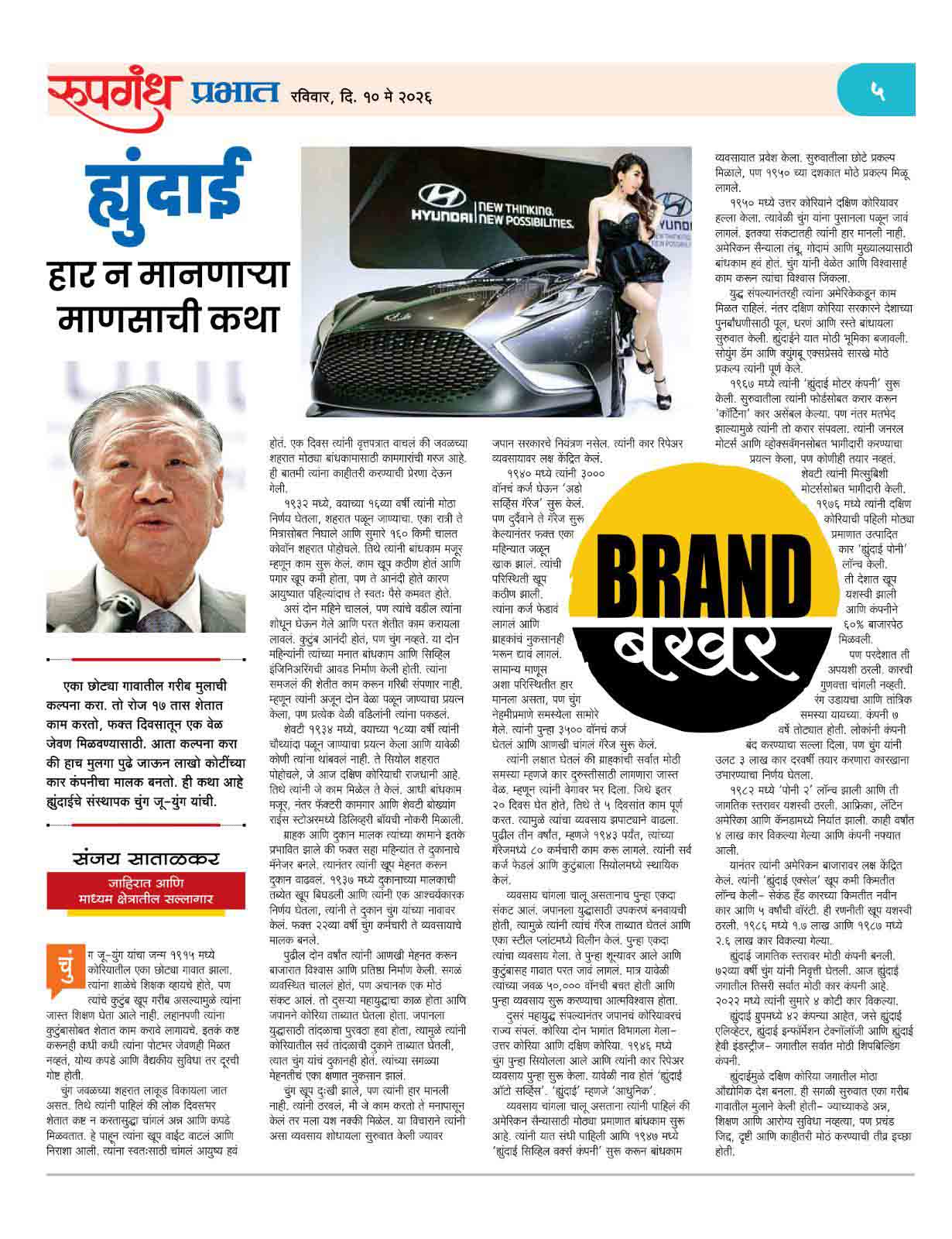
Hyundai: The Story of a Man Who Never Gave Up
Imagine a poor boy from a small village. He works in the fields for 17 hours every day just to get one meal a day. Now imagine that the same boy grows up to become the owner of a multi-billion car company. This is the story of Chung Ju-yung, the founder of Hyundai.
Chung Ju-yung was born in 1915 in a small village in Korea. He wanted to become a school teacher, but due to extreme poverty, he could not get much education. As a child, he had to work in the fields with his family. Even after such hard work, he often didn’t get enough food. Proper clothes and medical facilities were far beyond reach.
He used to go to a nearby town to sell firewood. There, he saw people living comfortably without working all day in the fields. This made him feel frustrated and disappointed. He wanted a better life. One day, he read in a newspaper that workers were needed for a big construction project in a nearby city. This inspired him to do something.
In 1932, at the age of 16, he made a bold decision to run away to the city. One night, he left with a friend and walked about 160 km to reach Kowon. There, he started working as a construction labourer. The work was tough and the pay was low, but he was happy because for the first time, he was earning his own money.
This continued for two months, but his father found him and brought him back to work on the farm. His family was happy, but Chung was not. Those two months had sparked his interest in construction and civil engineering. He realized that farming would not end his poverty. He tried to run away two more times, but each time his father brought him back.
Finally, in 1934, at the age of 18, he ran away for the fourth time, and this time no one stopped him. He reached Seoul, now the capital of South Korea. He took up any job he could find construction labourer, factory worker, and eventually a delivery boy at Bokyung Rice Store.
Both customers and the shop owner were so impressed with his work that within just six months, he became the store manager. With hard work, he expanded the business. In 1937, when the owner fell seriously ill, he made a surprising decision he transferred ownership of the store to Chung. At just 22, Chung went from being an employee to a business owner.
Over the next two years, he worked even harder and built trust and reputation in the market. Everything was going well when suddenly a major crisis struck. It was the time of World War II, and Japan had occupied Korea. Japan needed rice for the war, so they took control of all rice stores including Chung’s. His entire hard work was wiped out in a moment.
Chung was deeply upset but did not give up. He decided, “If I do any work sincerely, I will succeed.” He started looking for a business that would not be controlled by the Japanese government. He chose the car repair business.
In 1940, he took a loan of 3000 won and started “Ado Service Garage.” Unfortunately, within just a month, the garage burned down. His situation became very difficult. He had to repay the loan and compensate customers. Anyone else might have given up, but Chung faced the challenge. He took another loan of 3500 won and started a better garage.
He realized that customers’ biggest problem was the long repair time. So he focused on speed. While others took 20 days, he completed repairs in just 5 days. His business grew rapidly. Within three years, by 1943, he had 80 employees. He repaid all loans and settled his family in Seoul.
Just when things were going well, another crisis hit. Japan took over his garage and merged it into a steel plant for war purposes. Once again, he lost everything. He returned to his village with his family. However, this time he had savings of 50,000 won and confidence to restart.
After World War II, Japan’s rule over Korea ended. Korea was divided into North and South. In 1946, Chung returned to Seoul and restarted his car repair business under the name “Hyundai Auto Service.” “Hyundai” means “modern.”
As the business grew, he noticed large-scale construction work being done for the American army. He saw an opportunity and in 1947 started “Hyundai Civil Works Company,” entering the construction business. Initially, he got small projects, but by the 1950s, he began receiving large contracts.
In 1950, North Korea attacked South Korea. Chung had to flee to Busan. Even in such difficult times, he didn’t give up. The American army needed construction for tents, warehouses, and headquarters. Chung earned their trust by delivering work on time.
After the war, he continued getting contracts from the Americans. Later, the South Korean government began rebuilding the country by constructing bridges, dams, and roads. Hyundai played a major role in projects like the Soyang Dam and Gyeongbu Expressway.
In 1967, he started Hyundai Motor Company. Initially, they assembled “Cortina” cars in partnership with Ford. Later, due to disagreements, the partnership ended. He tried collaborating with General Motors and Volkswagen, but no one agreed.
Finally, he partnered with Mitsubishi Motors. In 1976, they launched South Korea’s first mass-produced car, “Hyundai Pony.” It was highly successful in the domestic market, capturing 60% market share.
However, it failed in international markets due to poor quality paint issues and technical problems. The company suffered losses for 7 years. People advised him to shut it down, but instead, Chung decided to build a factory capable of producing 300,000 cars annually.
In 1982, “Pony 2” was launched and became globally successful. It was exported to Africa, Latin America, and Canada. Within a few years, 400,000 cars were sold and the company became profitable.
Next, he targeted the American market. He launched the “Hyundai Excel” at a very low price with the cost of a second-hand car, a brand new car, and a 5 year warranty. This strategy worked brilliantly. In 1986, 170,000 cars were sold, and in 1987, 260,000 cars.
Hyundai became a global giant. At the age of 72, Chung retired. Today, Hyundai is among the world’s largest car companies. In 2022, it sold around 40 million cars.
The Hyundai Group includes 42 companies such as Hyundai Elevator, Hyundai Information Technology, and Hyundai Heavy Industries the world’s largest shipbuilding company.
Because of Hyundai, South Korea became a major industrial nation. And it all began with a poor village boy who had no food, education, or healthcare, but had immense determination, vision, and the strong desire to achieve something big.
Author: Sanjay Satalkar
Advertising and Marketing Consultant