

AI Advantages and Disadvantages: Benefits, Risks & Real-World Impact in 2026
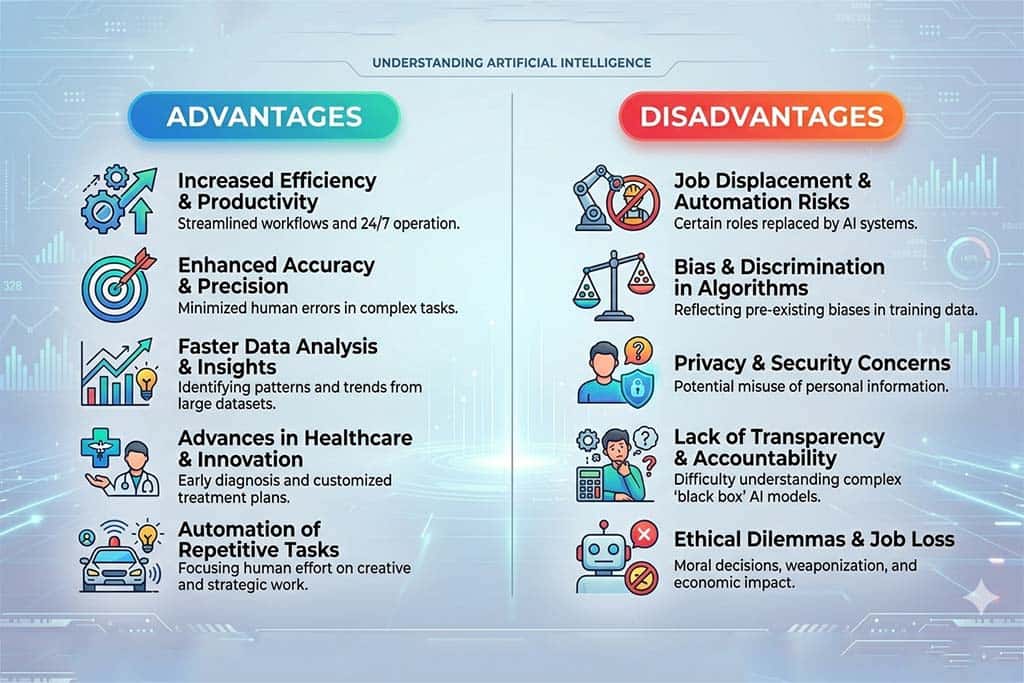
AI Advantages and Disadvantages: Benefits, Risks & Real-World Impact in 2026
Artificial Intelligence (AI) has rapidly transformed the way businesses operate, communicate, and make decisions. From personalized recommendations on streaming platforms to advanced automation in manufacturing, AI is becoming an integral part of everyday life. While AI offers remarkable opportunities for innovation and efficiency, it also presents challenges that organizations and individuals must carefully address.
In this article, we explore the key advantages and disadvantages of AI and how it is shaping the future of industries worldwide.
What is Artificial Intelligence?
Artificial Intelligence refers to the ability of machines and computer systems to simulate human intelligence. AI-powered systems can learn from data, recognize patterns, make decisions, solve problems, and even generate content with minimal human intervention.
Today, AI is used across industries such as healthcare, finance, education, manufacturing, retail, agriculture, and marketing to improve productivity and enhance customer experiences.
Advantages of Artificial Intelligence
1. Increased Efficiency and Productivity
One of the biggest benefits of AI is its ability to automate repetitive and time-consuming tasks. Businesses can use AI to handle data entry, customer support, scheduling, inventory management, and many other routine operations.
This allows employees to focus on strategic and creative work while reducing operational costs.
2. Faster Decision-Making
AI systems can analyze vast amounts of data in seconds and provide actionable insights. Organizations can make faster and more informed decisions based on real-time information.
For example, AI helps businesses predict customer behavior, optimize supply chains, and identify market trends more accurately.
3. Improved Accuracy
Unlike humans, AI systems do not suffer from fatigue or distractions. When trained correctly, AI can perform tasks with a high level of accuracy and consistency.
Industries such as healthcare use AI to assist in disease diagnosis, medical imaging analysis, and treatment recommendations.
4. Enhanced Customer Experience
AI-powered chatbots, virtual assistants, and recommendation engines help businesses provide personalized experiences to customers.
Online platforms use AI to suggest products, movies, music, and services based on individual preferences, improving engagement and satisfaction.
5. 24/7 Availability
AI systems can operate continuously without breaks, holidays, or downtime. This makes them particularly useful for customer service, security monitoring, and global business operations.
Organizations can provide round-the-clock support while reducing the need for large support teams.
6. Innovation and Business Growth
AI enables companies to develop new products, services, and business models. It helps organizations identify opportunities, improve efficiency, and gain a competitive advantage in the market.
From autonomous vehicles to smart agriculture, AI is driving innovation across multiple sectors.
Disadvantages of Artificial Intelligence
1. Job Displacement Concerns
Automation can reduce the need for certain types of jobs, particularly those involving repetitive and routine tasks.
While AI creates new opportunities, workers may need reskilling and up skilling to adapt to changing job requirements.
2. High Development and Implementation Costs
Building and maintaining AI systems often requires significant investments in technology, infrastructure, and skilled professionals.
For small businesses, adopting advanced AI solutions can be costly and challenging.
3. Lack of Human Creativity and Emotional Intelligence
AI can process information and recognize patterns, but it lacks genuine creativity, empathy, and emotional understanding.
Tasks involving complex human relationships, leadership, negotiation, and emotional support still require human involvement.
4. Data Privacy and Security Risks
AI systems rely heavily on data. If sensitive information is not managed properly, organizations may face privacy breaches and cyber security threats.
Ensuring responsible data usage and compliance with regulations is essential.
5. Bias and Ethical Concerns
AI systems learn from historical data. If the training data contains biases, the AI model may produce unfair or discriminatory outcomes.
Organizations must regularly monitor AI systems to ensure fairness, transparency, and accountability.
6. Dependence on Technology
Excessive reliance on AI can reduce human involvement in critical decision-making processes. System failures, technical issues, or inaccurate data can lead to costly mistakes.
Maintaining human oversight remains important in high-stakes applications.
How Businesses Can Use AI Responsibly
To maximize the benefits of AI while minimizing risks, organizations should:
- Implement strong data security measures.
- Maintain human oversight for important decisions.
- Regularly audit AI systems for bias and fairness.
- Invest in employee training and reskilling.
- Follow ethical AI guidelines and regulatory requirements.
A balanced approach ensures that AI serves as a tool to enhance human capabilities rather than replace them entirely.
Conclusion
Artificial Intelligence is revolutionizing industries by improving efficiency, accuracy, and innovation. Its ability to automate tasks, analyse data, and enhance customer experiences makes it one of the most powerful technologies of the modern era.
However, AI also brings challenges related to employment, privacy, ethics, and technological dependence. Organizations that adopt AI responsibly and strategically will be better positioned to leverage its advantages while addressing potential risks.
As AI continues to evolve, the future will belong to businesses and individuals who embrace innovation while maintaining a strong focus on ethics, transparency, and human-centered decision-making.