

LEGO
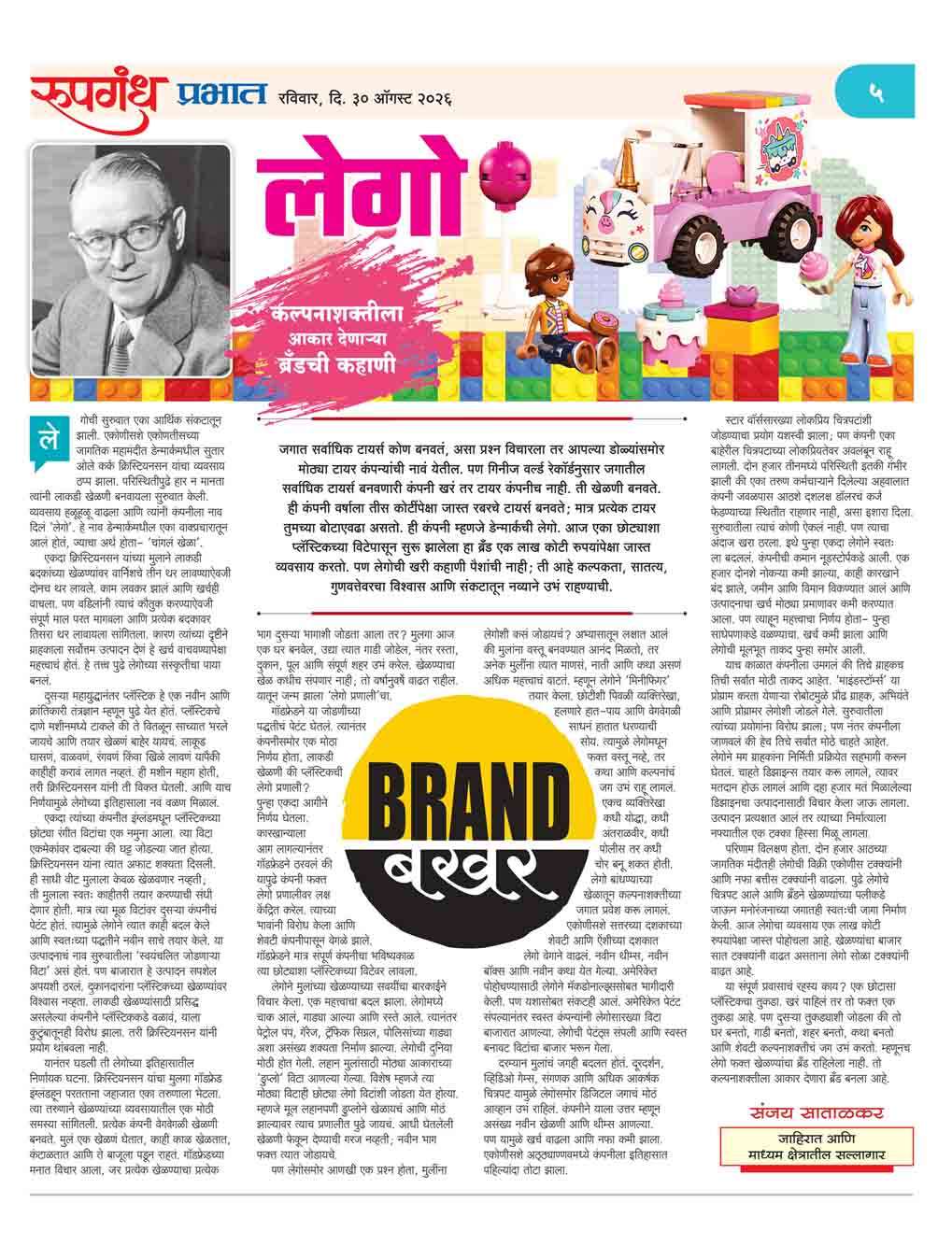
LEGO: The Story of a Brand That Gives Shape to Imagination
If you are asked which company makes the most tyres in the world, you would probably think of the names of large tyre companies. But according to the Guinness World Records, the company that makes the most tyres in the world is actually not a tyre company at all. It makes toys. This company makes more than 300 million rubber tyres every year; however, each tyre is only about the size of your finger. This company is Denmark’s LEGO. Today, this brand, which started with a small plastic brick, has a business worth more than ₹1 lakh crore. But the real story of LEGO is not about money; it is about creativity, persistence, faith in quality, and the ability to rise again after a crisis.
LEGO began during a financial crisis. During the Great Depression of 1929, the business of a Danish carpenter named Ole Kirk Christiansen came to a standstill. Instead of giving up in front of the difficult situation, he started making wooden toys. The business slowly grew, and he named the company ‘LEGO’. The name came from a Danish phrase that meant ‘Play well’.
Once, Christiansen’s son applied only two coats of varnish to the wooden duck toys instead of three. The work was completed faster and some money was saved. But instead of praising him, his father asked him to bring back the entire batch and apply a third coat of varnish to every duck. For him, giving the customer the best possible product was more important than saving costs. This principle later became the foundation of LEGO’s culture.
After the Second World War, plastic was emerging as a new and revolutionary technology. Plastic pellets were put into a machine, melted and filled into moulds, and the finished toy came out. There was no need to sand, dry, paint or use nails as was required with wooden toys. The machine was expensive, but Christiansen decided to buy it. And this decision gave a completely new direction to the history of LEGO.
One day, a sample of small, colourful plastic bricks arrived at his company from England. When these bricks were pressed together, they connected firmly with each other. Christiansen saw tremendous possibilities in them. This simple brick was not just something for a child to play with; it would give the child an opportunity to create something of their own. However, the original bricks were protected by another company’s patent. So LEGO made some changes and created new moulds in its own way. The product was initially called ‘Automatic Binding Bricks’. But the product failed completely in the market. Shopkeepers did not trust plastic toys. Even within the family, there was opposition to a company known for wooden toys moving towards plastic. Yet Christiansen did not stop experimenting.
Then came the decisive moment in LEGO’s history. While travelling back from England, Christiansen’s son Godtfred met a young man on the ship. The young man told him about a major problem in the toy business. Every company made different toys. Children bought a toy, played with it for some time, got bored and then left it lying around. Godtfred had an idea: What if every part of every toy could be connected to every other part? A child could build a house today, add a car to it tomorrow, then build a road, a shop, a bridge and eventually an entire city. The play would never really end; it would keep growing for years. This idea gave birth to the ‘LEGO System’.
Godtfred patented this method of connecting the bricks. The company now faced a major decision: wooden toys or the plastic LEGO System? Once again, fire made the decision. After a fire destroyed the factory, Godtfred decided that from then on, the company would focus only on the LEGO System. His brothers opposed the decision and eventually separated from the company. But Godtfred decided to place the entire future of the company on that small plastic brick.
LEGO carefully studied how children played with toys. An important change followed. Wheels were added to LEGO, then cars and roads. After that came petrol stations, garages, traffic signals, police cars and countless other possibilities. The world of LEGO kept getting bigger.
For small children, larger ‘DUPLO’ bricks were introduced. Interestingly, these larger bricks could also be connected to the smaller LEGO bricks. This meant that a child could play with DUPLO when young and continue with the same system as they grew older. There was no need to throw away the toys bought earlier; new parts could simply be added to them.
But LEGO faced another question: How could it connect girls with LEGO? Research showed that while boys enjoyed building objects, many girls found it more important to have people, relationships and stories within those creations. So LEGO created the ‘Minifigure’. It was a small yellow character with movable arms and legs and the ability to hold different tools and accessories. Because of this, LEGO was no longer just about building objects; it began creating a world of stories and imagination. The same character could become a warrior, an astronaut, a police officer or a thief. LEGO became a way to enter the world of imagination through the act of building.
By the late 1970s and during the 1980s, LEGO grew rapidly. New themes, new boxes and new stories kept coming. To reach the American market, LEGO partnered with McDonald’s. But success also brought challenges. After patents expired in America, cheaper companies began producing bricks similar to LEGO’s. LEGO’s patents expired, and the market became flooded with cheaper imitation bricks.
Meanwhile, the world of children was also changing. Television, video games, computers and increasingly attractive movies created a major challenge for LEGO from the digital world. The company responded by introducing countless new toys and themes. But this increased costs and reduced profits. In 1998, the company suffered a loss for the first time in its history.
The experiment of connecting LEGO with popular movies such as Star Wars was successful; however, the company gradually became dependent on the popularity of an outside movie. By 2003, the situation had become so serious that a report prepared by a young employee warned that the company might not be in a position to repay nearly 800 million dollars in debt. Initially, nobody listened to him. But his prediction came true. Once again, LEGO changed itself.
Niels Christiansen took charge of the company. Around 1,200 jobs were cut, some factories were closed, land and an aircraft were sold, and production costs were reduced on a large scale. But the more important decision was to return to simplicity. Costs came down and LEGO’s fundamental strength once again came to the forefront.
During this period, the company realised that its customers were its greatest strength. The robots that could be programmed through ‘Mindstorms’ brought adult customers, engineers and programmers closer to LEGO. Initially, there was opposition to their experiments. But later, the company realised that these people were among its biggest fans. LEGO then began involving customers in its creation process. Fans started creating designs, people voted on them, and designs that received 10,000 votes were considered for production. If a design was actually produced, its creator began receiving a share of the profits.
The result was remarkable. Even during the global recession of 2008, LEGO’s sales increased by 19 percent and its profits increased by 32 percent. Later, LEGO movies were made, and the brand went beyond toys to establish its own place in the world of entertainment as well. Today, LEGO’s business has crossed ₹1 lakh crore. While the toy market is growing at 7 percent, LEGO is growing at 16 percent.
And what is the secret behind this entire journey? One small piece of plastic. At first glance, it is just a small piece. But when it connects with another piece, it can become a house, a car, a city, a story and, ultimately, an entire world of imagination. And that is why LEGO is no longer just a toy brand. It has become a brand that gives shape to imagination.
Author: Sanjay Satalkar
Advertising and Marketing Consultant