

Fevicol
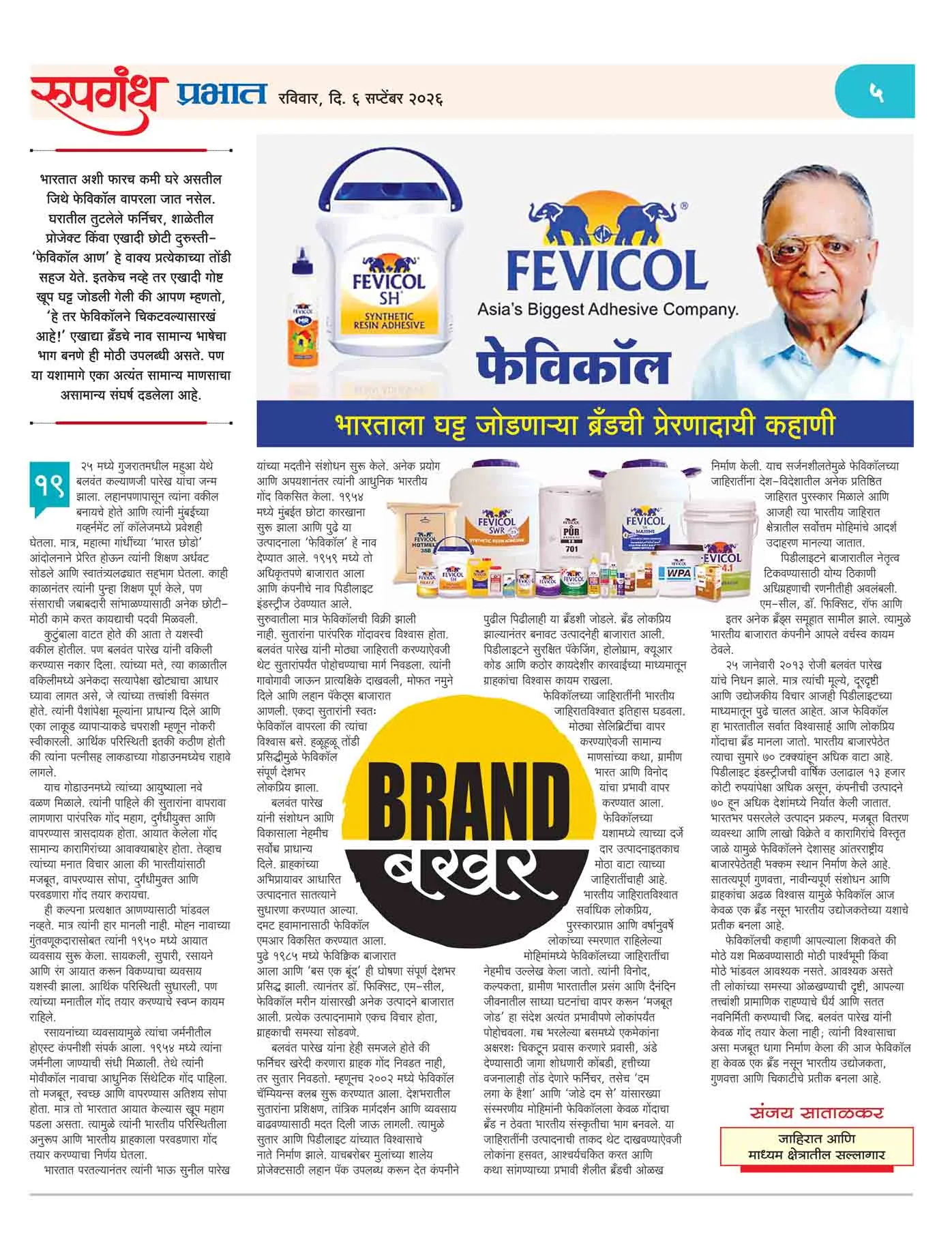
Fevicol – The Inspiring Story of the Brand That Glued India Together
There would hardly be any home in India where Fevicol is not used. Whether it is repairing broken furniture at home, making a school project, or doing a small repair job, the words “Bring Fevicol” come naturally to everyone. Not just that, whenever something is joined very strongly, we often say, “It is as if it has been stuck with Fevicol!” When a brand name becomes a part of everyday language, it is a great achievement. But behind this success is the extraordinary struggle of a very ordinary man.
Balwant Kalyanji Parekh was born in 1925 in Mahuva, Gujarat. From childhood, he wanted to become a lawyer, and he even joined the Government Law College in Mumbai. However, inspired by Mahatma Gandhi’s “Quit India” Movement, he left his education midway and took part in the freedom struggle. Later, he completed his education, but to support his family, he did several small and big jobs while completing his law degree.
His family believed that he would now become a successful lawyer. But Balwant Parekh refused to practise law. According to him, the legal profession at that time often required people to depend on lies rather than truth, which went against his principles. He gave more importance to values than money and accepted a job as a peon with a timber merchant. His financial condition was so difficult that he had to live with his wife in the timber warehouse itself.
It was in this warehouse that his life took a new direction. He noticed that the traditional glue used by carpenters was expensive, smelly and difficult to use. Imported glue was beyond the reach of ordinary craftsmen. That was when he got the idea of creating a glue for Indians that would be strong, easy to use, odour-free and affordable.
He had no capital to turn this idea into reality. But he did not give up. In 1950, he started an import business with an investor named Mohan. The business of importing and selling bicycles, betel nuts, chemicals and colours became successful. His financial situation improved, but his dream of making glue remained alive.
His chemicals business brought him in contact with the German company Hoechst. In 1954, he got an opportunity to visit Germany. There, he saw a modern synthetic adhesive called “Movicol”. It was strong, clean and extremely easy to use. However, importing it into India would have made it very expensive. Therefore, he decided to develop a glue suited to Indian conditions and affordable for Indian consumers.
After returning to India, he started research with the help of his brother, Sunil Parekh. After many experiments and failures, they developed a modern Indian adhesive. In 1954, a small factory was started in Mumbai, and the product was later named “Fevicol”. In 1959, it was officially launched in the market, and the company was named Pidilite Industries.
Initially, however, Fevicol did not sell well. Carpenters trusted the traditional glue they had been using for years. Instead of spending heavily on advertising, Balwant Parekh chose to reach the carpenters directly. He travelled from village to village, demonstrated the product, gave free samples and introduced small packs into the market. Once carpenters started using Fevicol themselves, they became convinced of its quality. Slowly, through word-of-mouth publicity, Fevicol became popular across the country.
Balwant Parekh always gave the highest priority to research and development. The product was continuously improved based on customer feedback. Fevicol MR was developed for humid weather conditions. Later, in 1985, Fevikwik was launched, and the slogan “Bas Ek Boond” became famous across the country. After that, many other products such as Dr. Fixit, M-Seal and Fevicol Marine were introduced. There was one common thought behind every product – to solve the customer’s problem.
Balwant Parekh also understood that a customer buying furniture does not choose the glue; the customer chooses the carpenter. Therefore, in 2002, the “Fevicol Champions Club” was launched. Carpenters across the country began receiving training, technical guidance and support to grow their businesses. This helped build a relationship of trust between carpenters and Pidilite. At the same time, the company introduced small packs for children’s school projects, connecting the next generation with the brand. After the brand became popular, counterfeit products also entered the market. Pidilite protected customer trust through secure packaging, holograms, QR codes and strict legal action.
Fevicol’s advertising created history in the Indian advertising industry. Instead of using big celebrities, the brand effectively used stories of ordinary people, rural India and humour. Fevicol’s advertising has played as important a role in its success as the quality of its product. Fevicol advertisements are always mentioned among the most popular, award-winning and memorable campaigns in Indian advertising over the years. Through humour, creativity, situations from rural India and simple incidents from everyday life, they communicated the message of a “strong bond” very effectively.
Passengers travelling literally stuck to one another in an overcrowded bus, a hen looking for a place to lay its eggs, furniture strong enough to withstand the weight of an elephant, and memorable campaigns such as “Dum Laga Ke Haisha” and “Jode Dum Se” made Fevicol more than just a glue brand – they made it a part of Indian culture. Instead of directly demonstrating the strength of the product, these advertisements built the brand through humour, surprise and powerful storytelling. This creativity helped Fevicol win several prestigious advertising awards in India and abroad, and even today its campaigns are considered classic examples of some of the best work in Indian advertising.
Pidilite also adopted a strategic acquisition approach to maintain its leadership in the market. Brands such as M-Seal, Dr. Fixit, Roff and many others became part of the group. This helped the company maintain its strong position in the Indian market.
Balwant Parekh passed away on 25 January 2013. However, his values, vision and entrepreneurial thinking continue through Pidilite even today. Fevicol is now considered one of India’s most trusted and popular adhesive brands. It has a market share of more than 70 percent in the Indian market. Pidilite Industries has an annual turnover of more than ₹13,000 crore, and its products are exported to more than 70 countries.
With manufacturing plants spread across India, a strong distribution network, and a vast network of millions of retailers and craftsmen, Fevicol has built a strong position not only in India but also in international markets. Consistent quality, innovative research and the unwavering trust of customers have made Fevicol more than just a brand. It has become a symbol of the success of Indian entrepreneurship.
The story of Fevicol teaches us that great success does not require a great background or huge capital. What is required is the vision to identify people’s problems, the courage to remain true to one’s principles, and the determination to keep innovating. Balwant Parekh did not merely create a glue; he created such a strong bond of trust that today “Fevicol” is not just a brand, but a symbol of Indian entrepreneurship, quality and perseverance.
Author: Sanjay Satalkar
Advertising and Marketing Consultant