

Safari Bags
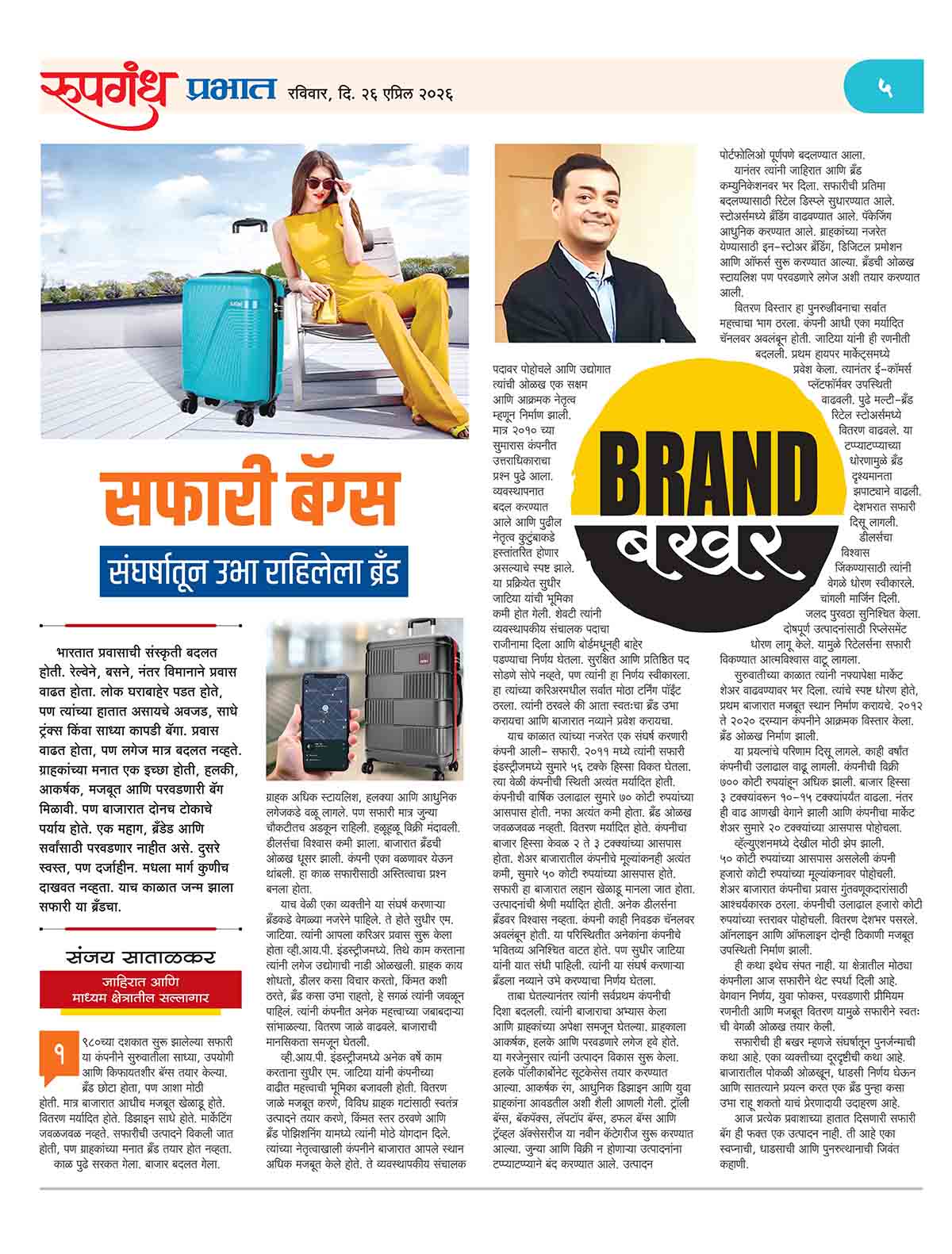
Safari Bags – A Brand that Rose from Struggle
Travel culture in India was changing. Travel by train, bus, and later by airplane was increasing. People were stepping out of their homes more often, but in their hands were heavy trunks or simple cloth bags. Travel was growing, but luggage was not evolving. Customers had a clear desire — they wanted bags that were lightweight, attractive, strong, and affordable. However, the market offered only two extreme options. One was expensive branded luggage that was not affordable for everyone. The other was cheap but poor in quality. No one was offering the middle path.
During this time, the Safari brand was born. Started in the 1980s, the company initially produced simple, functional, and affordable bags. The brand was small, but the ambition was big. However, strong players already dominated the market. Distribution was limited. Designs were basic. Marketing was almost non-existent. Safari products were selling, but the brand was not being built in customers’ minds.
Time moved forward. The market changed. Customers began shifting towards stylish, lightweight, and modern luggage. But Safari remained stuck in the old framework. Slowly sales started declining. Dealer confidence reduced. Brand recognition faded in the market. The company reached a turning point. This period became a survival challenge for Safari.
At this stage, one person looked at this struggling brand differently. That person was Sudhir M. Jatia. He began his career at VIP Industries. While working there, he understood the pulse of the luggage industry. What customers want, how dealers think, how pricing works, and how brands are built — he observed everything closely. He handled many important responsibilities in the company. He expanded the distribution network. He understood the mindset of the market.
While working at VIP Industries for many years, Sudhir Jatia played a major role in the company’s growth. Strengthening the distribution network, creating separate products for different customer segments, defining pricing levels, and building brand positioning — he contributed significantly. Under his leadership, the company strengthened its market position. He rose to the position of Managing Director and built a reputation as a capable and aggressive leader in the industry.
However, around 2010, the issue of succession emerged in the company. Owner Dilip Piramal decided to keep future leadership within the family and initiated the process of bringing his daughter Radhika Piramal into leadership. Management changes were made, and it became clear that leadership would transition to the family. In this process, Sudhir Jatia’s role began to reduce. Despite his major contribution, a situation developed where he was being sidelined. Finally, he resigned from the Managing Director position and stepped down from the board. Leaving a secure and prestigious position was not easy, but he accepted the decision. This became the biggest turning point in his career. He decided to build his own brand and re-enter the market.
At the same time, he noticed a struggling company — Safari. In 2011, he acquired about 56 percent stake in Safari Industries. At that time, the company’s condition was very limited. Annual turnover was around seventy crore rupees. Profit was very low. Brand recognition was almost absent. Distribution was limited. Market share was only around two to three percent. The company’s valuation in the stock market was extremely low, around fifty crore rupees. Safari was considered a small third-rank player in the market. Product range was limited. Many dealers did not trust the brand. The company depended on select channels. Many believed the company’s future was uncertain. But Sudhir Jatia saw an opportunity. He decided to rebuild this struggling brand.
After taking control, he first changed the company’s direction. He studied the market and understood customer expectations. Customers wanted attractive, lightweight, and affordable luggage. Based on this need, he started product development. Lightweight polycarbonate suitcases were introduced. Attractive colors, modern designs, and youth-focused styling were added. New categories like trolley bags, backpacks, laptop bags, duffle bags, and travel accessories were launched. Old and non-performing products were gradually discontinued. The product portfolio was completely transformed.
He then focused on advertising and brand communication. Retail displays were improved to change Safari’s image. Store branding was increased. Packaging was modernized. In-store branding, digital promotions, and offers were introduced to attract customers. The brand identity was built as “stylish yet affordable luggage.”
Distribution expansion became the most important part of the revival. Earlier, the company depended on limited channels. Jatia changed this strategy. He first entered hypermarkets. Then he expanded presence on e-commerce platforms. Later, distribution was increased in multi-brand retail stores. This step-by-step approach rapidly increased brand visibility. Safari began to appear across the country.
To win dealer confidence, he adopted a different strategy. He offered better margins. Ensured faster supply. Implemented replacement policies for defective products. This gave retailers confidence to sell Safari.
In the early phase, he focused on increasing market share rather than profit. His clear strategy was to first build a strong market position. Between 2012 and 2020, the company expanded aggressively. Brand recognition increased.
The results of these efforts started appearing. Within a few years, turnover began to grow. Sales crossed seven hundred crore rupees. Market share increased from three percent to around fifteen percent. Later, growth accelerated further and market share reached around twenty percent.
Valuation also saw a massive jump. A company valued at around fifty crore rupees reached a valuation of thousands of crores. The company’s journey in the stock market surprised investors. Turnover reached the level of thousands of crores. Distribution expanded across the country. Strong presence was created both online and offline.
The story does not end here. The same VIP where Jatia once worked is now directly challenged by Safari. Fast decision-making, youth focus, affordable premium strategy, and strong distribution helped Safari build its own identity.
The Safari story is a tale of rebirth through struggle. It is the story of one person’s vision. It is an inspiring example of how a brand can be rebuilt by identifying market gaps, taking bold decisions, and making consistent efforts. Today, the Safari bag seen in the hands of travelers is not just a product. It is a living story of a dream, courage, and revival.
Author: Sanjay Satalkar
Advertising and Marketing Consultant