

Ather
Ather – The Future Journey That Began with a Battery
When the morning rush begins in Indian cities, the roads overflow with a sea of vehicles. Smoke, noise, rising fuel prices, and lack of time make daily travel increasingly difficult. Many people see these problems as unavoidable, but some see opportunity in them. This is the inspiring story of determination, vision, and innovation — the story of Ather Energy.
This story begins with the thoughts of two young minds, Tarun Mehta and Swapnil Jain. Both were studying engineering at IIT Madras. From childhood, they had a curiosity to understand new things, open devices, and think about how they could be improved. For them, engineering was not just education; it was a mindset of asking questions and finding answers.
During their college days, they started studying electric vehicles. At that time, electric scooters were available in India, but they were not inspiring. Their speed was very low, technology was outdated, and the design was not attractive. People were buying electric vehicles not because they were eco-friendly, but because they had no alternative. This led to an important question in their minds — “Why are electric vehicles so poor in quality? Why can’t we build something better?”
Initially, their idea was not to build a scooter. They believed the main problem of electric vehicles was the battery. So they began working on battery technology. In a small hostel space, college labs, and with limited resources, they started designing batteries. Their aim was to create a strong, efficient, and reliable battery for electric vehicles in India.
But as their work progressed, they realized something important — the problem was not only the battery. The entire vehicle experience was weak. Customers did not just want a battery; they wanted a great, smart, and attractive product. This became the biggest turning point in their journey. They decided that they would not just build batteries — they would build a complete electric vehicle.
In this journey, the IIT Madras incubation center gave them strong support. They received advanced research facilities, experienced mentors, and most importantly, freedom to experiment. Even when they failed, the environment helped them stand up again. With this support, they took the bold decision to turn their ideas into reality.
To demonstrate their battery, they built a prototype scooter. It was just an experiment — a tool to show how capable their battery was. But this experiment changed their future. The prototype had something special — a combination of performance, design, and technology. They realized this was not just a scooter; it was an opportunity to create a completely new category.
In 2013, they officially started the company. This decision was not easy. They left stable career opportunities and chose uncertainty. The early days were extremely difficult. Financial limitations, technical challenges, and market uncertainty were all against them. Many experiments failed. The battery did not perform as expected, hardware problems occurred, and production timelines slipped. But they did not give up.
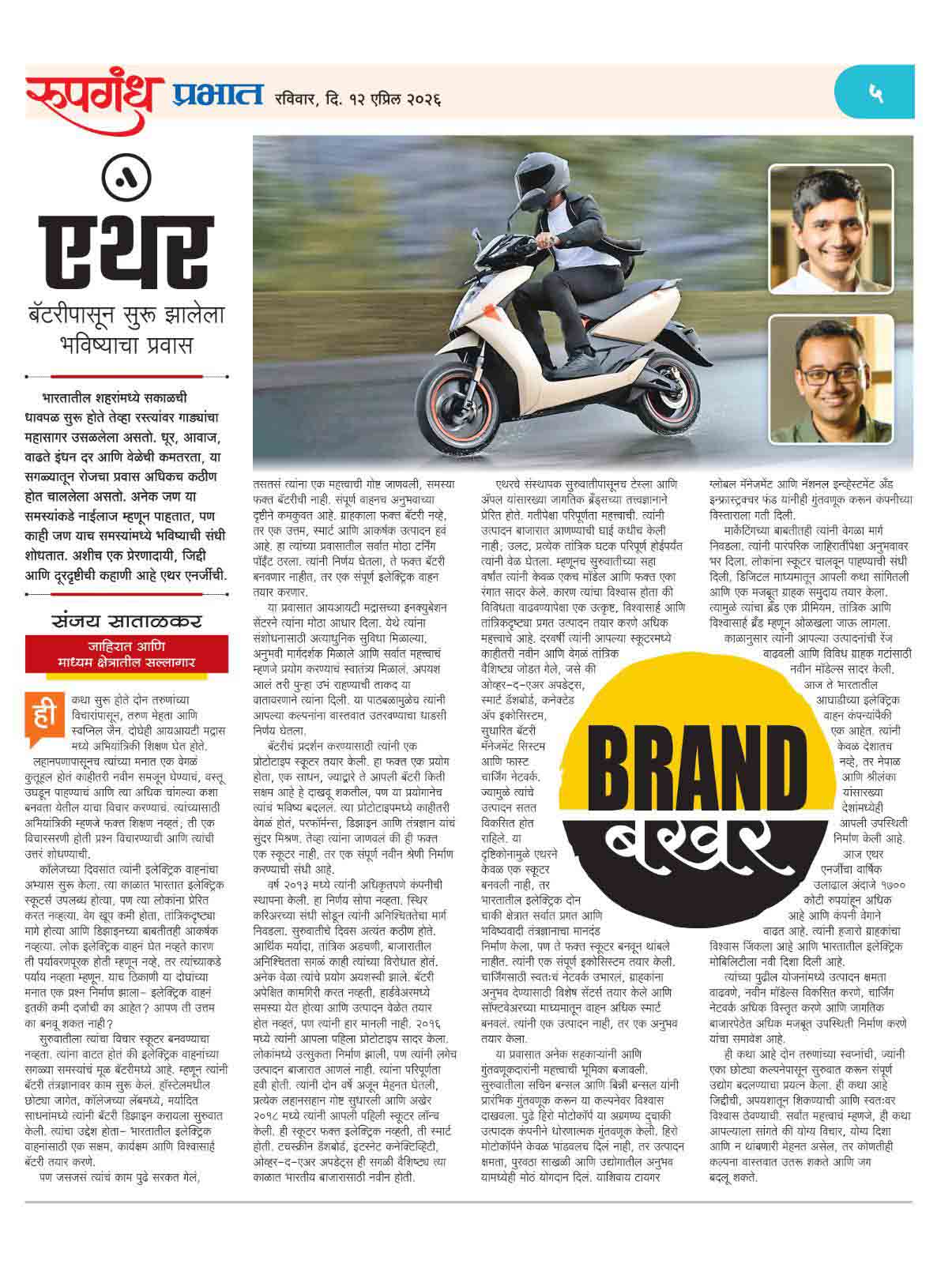
In 2016, they presented their first prototype. People became curious, but they did not immediately launch it in the market. They wanted perfection. They worked for two more years, improved every small detail, and finally launched their first scooter in 2018. This scooter was not just electric — it was smart. Features like a touchscreen dashboard, internet connectivity, and over-the-air updates were new to the Indian market at that time.
From the beginning, Ather’s founders were inspired by global brands like Tesla and Apple. “Perfection is more important than speed.” They never rushed to launch the product. Instead, they took time until every technical component was perfect. That is why in the first six years they launched only one model and in only one color. They believed that instead of increasing variety, it was more important to create one excellent, reliable, and technologically advanced product.
Every year they added new features to their scooter — over-the-air updates, smart dashboard, connected app ecosystem, improved battery management system, and fast-charging network. This helped their product continuously evolve. With this approach, Ather did not just build a scooter; they created a benchmark for “the most advanced and futuristic technology” in India’s electric two-wheeler segment.
But they did not stop at making scooters. They created a complete ecosystem. They built their own charging network, created experience centers for customers, and made vehicles smarter through software. They did not just create a product — they created an experience.
Many partners and investors played an important role in this journey. Initially, Sachin Bansal and Binny Bansal invested early and showed faith in the idea. Later, Hero MotoCorp, a leading two-wheeler manufacturer, made a strategic investment. Hero MotoCorp not only provided capital but also contributed to manufacturing capability, supply chain, and industry experience. Apart from this, Tiger Global Management and National Investment and Infrastructure Fund also invested and accelerated the company’s expansion.
Even in marketing, they chose a different path. Instead of traditional advertising, they focused on experience. They gave people opportunities to test ride the scooter, told their story through digital platforms, and built a strong customer community. As a result, their brand became known as a premium, technological, and reliable brand.
Over time, they expanded their product range and introduced new models for different customer groups. Today, they are one of India’s leading electric vehicle companies. They have established their presence not only in India but also in countries like Nepal and Sri Lanka.
Today, Ather Energy’s annual turnover is estimated to be more than ₹1700 crore, and the company is growing rapidly. They have won the trust of thousands of customers and given a new direction to electric mobility in India.
Their future plans include increasing production capacity, developing new models, expanding the charging network, and building a stronger presence in global markets.
This is the story of two young dreamers who started with a small idea and tried to change an entire industry. This is a story of determination, learning from failure, and believing in oneself. Most importantly, this story tells us that with the right thinking, right direction, and continuous hard work, any idea can become reality and change the world.
Author: Sanjay Satalkar
Advertising and Marketing Consultant