

Leela Hotels
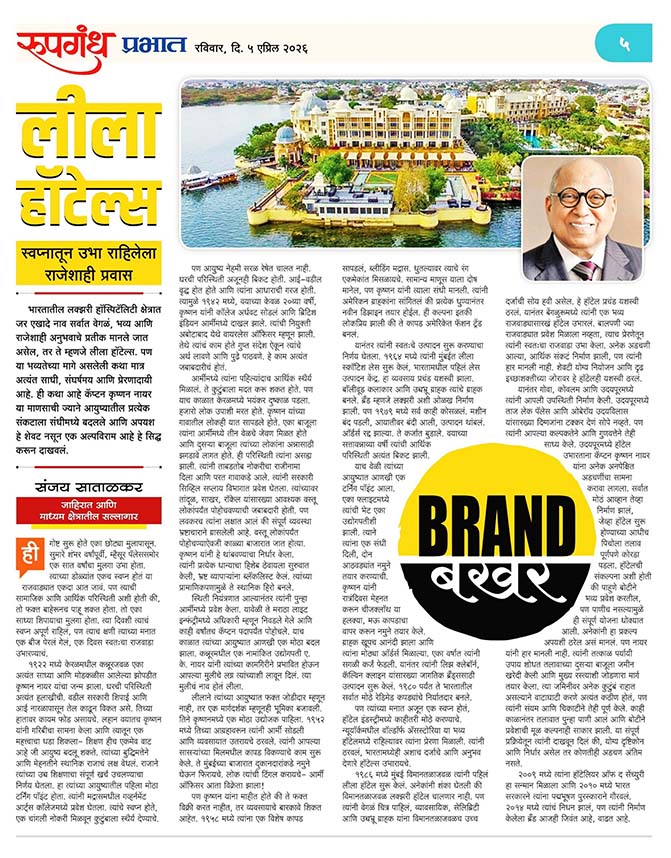
The Leela Hotels – A Royal Journey Built from a Dream
In India’s luxury hospitality industry, if there is one name that stands out as a symbol of grandeur and royal experience, it is The Leela Hotels. But the story behind this magnificence is simple, full of struggle, and truly inspiring. It is the story of Captain Krishnan Nair, a man who turned every challenge into an opportunity and proved that “failure is not the end, but just a pause.”
This story begins with a young boy. About a hundred years ago, a seven-year-old boy stood outside the Mysore Palace. He had only one dream—to step inside that royal palace someday. But due to his poor social and financial background, he could only look at it from outside. He was the son of a simple government worker. That day, his dream remained unfulfilled, but a seed was planted in his mind—to one day build his own “palace.”
In 1922, Krishnan Nair was born in a small, broken hut near Kannur in Kerala. His family was extremely poor. His father was a government peon, and his mother made coconut oil to sell, often working so hard that her hands developed blisters. From a young age, Krishnan faced poverty and learned an important lesson—“education is the only way to change life.”
He treated school like a temple and fully dedicated himself to studies. From Sanskrit to science, he worked hard in every subject. His intelligence and effort caught the attention of the local king, who decided to sponsor his higher education. This became the first major turning point in his life. He joined Government Arts College in Madras, dreaming of getting a good job and supporting his family.
But life doesn’t always move in a straight line. His family’s condition remained difficult, and his parents were aging. In 1942, at just 20 years old, he left college midway and joined the British Indian Army. He was posted in Abbottabad as a wireless officer. His job was to listen to secret messages, decode them, and pass them forward—a role with great responsibility.
For the first time, he achieved financial stability and could support his family. But during this period, a severe famine hit Kerala. Thousands were starving. While he had food in the army, his people were struggling for survival. This troubled him deeply.
He immediately resigned from the army and returned to his village. He joined the Civil Supplies Department, where he was responsible for distributing essential items like rice, sugar, and kerosene. Soon, he realized the system was filled with corruption—goods meant for people were being sold in the black market. Krishnan decided to stop this. He began tracking every grain and blacklisted corrupt traders. His honesty made him a local hero.
After stabilizing the situation, he rejoined the army. This time, he was selected as an officer in the Maratha Light Infantry and rose to the rank of Captain within a few years. During this time, another big change came in his life. A well-known industrialist, A.K. Nair, impressed by his work, got his daughter married to him. Her name was Leela.
Leela was not just his life partner but also his guide. She saw a great entrepreneur in him. In 1952, at her encouragement, he left the army and entered business. He started by selling textiles from his father-in-law’s mill. He would go shop to shop in Mumbai with samples. People mocked him—“An army officer has become a salesman!”
But Krishnan knew he was not just selling; he was learning business. In 1958, he discovered a unique fabric called “Bleeding Madras,” where colours blended after washing. While others saw it as a defect, he saw an opportunity. He marketed it in the U.S. as a fabric that creates a new design after every wash. It became a fashion trend in America.
He then decided to start his own manufacturing. In 1964, he launched “Leela Scottish Lace” in Mumbai, India’s first lace manufacturing unit. The business became highly successful. Bollywood celebrities and elite customers became his clients. The brand became a symbol of luxury.
But in 1979, everything collapsed. Machines stopped, imports were banned, production halted, and orders were cancelled. He fell into heavy debt. At the age of 57, he was financially broken.
At this critical moment, another turning point came. On a flight, he met a businessman who gave him an opportunity—to deliver samples within two weeks. Krishnan worked day and night and created samples using a soft fabric called cheesecloth. The client was impressed, leading to large orders. Within a year, he cleared all his debts.
He then began manufacturing for global brands like Liz Claiborne and Calvin Klein. By 1980, he became one of India’s largest exporters of ready-made garments.
But he still had a dream—to build something big in the hotel industry. His inspiration came after staying at the grand Waldorf Astoria in New York. He decided to create hotels in India that offered the same level of luxury and experience.
In 1986, he opened the first Leela Hotel near Mumbai airport. Many doubted the idea, saying luxury hotels wouldn’t work near an airport. But he saw opportunity—business travellers, celebrities, and elite guests would prefer convenience with luxury. The hotel became a huge success.
He then built a palace-like hotel in Bangalore. Inspired by the palace he once couldn’t enter as a child, he created his own “palace.” Despite financial challenges, his determination made it successful.
He expanded further into Goa, Kovalam, and Udaipur. Competing with giants like Taj Lake Palace and Oberoi Udaivilas in Udaipur was not easy, but he succeeded through creativity and quality.
During the construction of the Udaipur hotel, he faced a major challenge—the Pichola Lake dried up before the hotel opened. The concept of guests arriving by boat was at risk. Many believed the project would fail. But Krishnan didn’t give up. He quickly bought land on the other side and created a road connection. Negotiating with families living there was difficult, but he managed it with patience. Later, the lake refilled, and the original boat-entry concept was also restored. This proved that no challenge is final if you have vision and determination.
In 2009, he was honoured as “Hotelier of the Century,” and in 2010, the Government of India awarded him the Padma Bhushan. He passed away in 2014, but the brand he built continues to grow and represent India globally.
Today, The Leela Hotels is not just a hotel chain—it is a blend of Indian hospitality and world-class luxury.
Krishnan Nair always said, “Failure is not a full stop; it is just a comma.”
And that is the lesson this story teaches—dream big, fight through challenges, and never stop.
Author: Sanjay Satalkar
Advertising and Marketing Consultant