

Rolls Royce
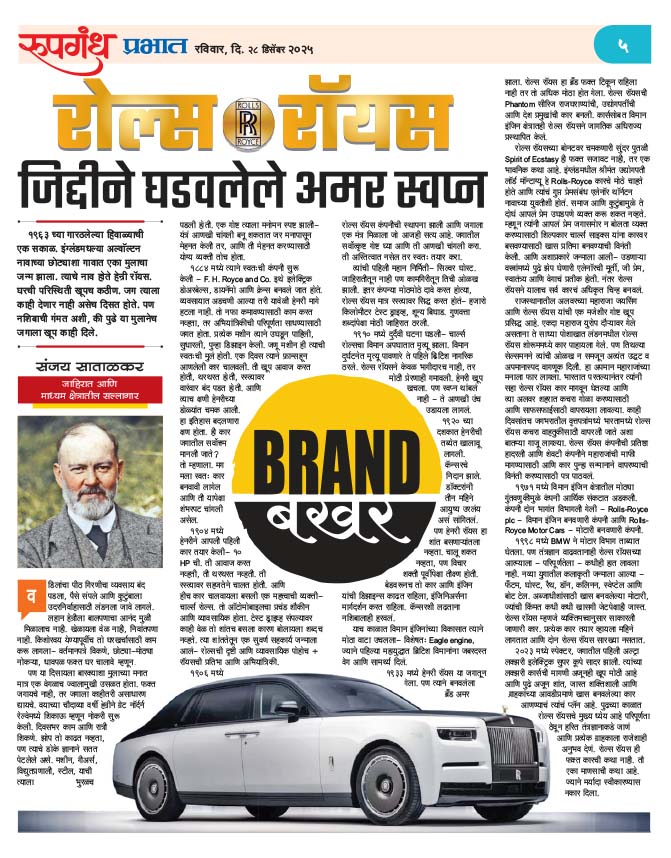
Rolls-Royce — An Immortal Dream Forged by Relentless Grit
It was a freezing winter morning in 1863. In a small village called Alwalton in England, a boy was born. His name was Henry Royce. His family’s condition was extremely difficult. It seemed as if the world had nothing to give him. But destiny had its own plans—because this very boy would one day give the world something extraordinary.
His father’s flour mill business collapsed, money ran out, and the family was forced to move to London in search of survival. Little Henry never truly experienced the joys of childhood. There was no time to play, no leisure, no comfort. Even before reaching his teenage years, he began working to support the household—selling newspapers, doing small jobs, running errands—just to keep the family going.
But inside this physically frail boy burned a powerful inner fire. He didn’t just want to survive; he wanted to give the world something exceptional. At the age of fourteen, Henry began working as an apprentice at the Great Northern Railway. Days were spent working, nights were spent studying. He barely slept, but his mind was constantly alive with knowledge. Machines, gears, electrical systems, steel—he was completely fascinated by them. One thing became very clear to him: machines could be made better—if someone worked on them with true dedication. And he believed that the right person to do that was himself.
In 1884, he started his own company—F. H. Royce & Co. The company manufactured electric doorbells, dynamos, and cranes. Even when business difficulties arose, Henry did not step back. He was not working merely to earn profits; he was living to achieve engineering perfection. He personally dismantled every machine, improved it, redesigned it. It was as if the machines were his own children.
One day, he drove a car imported from France. It was noisy, it vibrated heavily, and it frequently broke down on the road. At that very moment, a spark lit up in Henry’s eyes. This was a history-changing moment. “This is considered the best car in the world?” he asked. “Then I will have to build my own—and it will be a hundred times better.”
In 1904, Henry built his first car—the 10 HP. It was quiet. It didn’t vibrate. It ran smoothly on the road. And one important person got behind its wheel—Charles Rolls. He was a passionate automobile enthusiast and a businessman. After the test drive, he sat silently for a while, simply because he had no words. From that silence was born a golden partnership—Rolls’ vision and business reach combined with Royce’s genius and engineering brilliance.
In 1906, the Rolls-Royce company was founded, and the world received a mantra that remains true even today:
“Take the best that exists and make it better. If it does not exist, create it.”
Their first legendary creation was the Silver Ghost. It did not become famous through advertising, but through performance. While other companies made tall claims, Rolls-Royce proved itself on the road—thousands of kilometers of test drives with zero breakdowns. Quality itself became the greatest advertisement.
In 1910, a tragic incident occurred—Charles Rolls died in an aircraft accident. He became the first British citizen to die in an aviation crash. Rolls-Royce lost not just a partner, but a powerful source of inspiration. Henry was deeply shaken. But the dream did not stop—it began to soar even higher.
In the 1920s, Henry’s health began to decline. He was diagnosed with cancer. Doctors told him he had only three months to live. But Henry Royce was not someone who could sit idle. He could no longer walk, but his thinking was sharper than ever. From his bed, he continued designing cars and engines, guiding engineers, refining ideas. While fighting cancer, he even defeated fate itself.
During this period, he made a major contribution to the development of aircraft engines—especially the Eagle engine, which gave British aircraft tremendous speed and power during the First World War.
In 1933, Henry Royce passed away. But the brand he created became immortal. Rolls-Royce did not merely survive—it grew even greater. The Rolls-Royce Phantom series became the preferred car of royal families, industrialists, and heads of state. Along with luxury cars, Rolls-Royce also established global dominance in the aircraft engine sector.
The beautiful figurine shining on the bonnet of a Rolls-Royce—the “Spirit of Ecstasy”—is not just decoration, but an emotional story. Lord Montagu, a wealthy British aristocrat, was a great admirer of Rolls-Royce cars and had a secret love affair with a young woman named Eleanor Thornton. Due to society and family pressures, they could not openly express their love. To express it silently to the world, Lord Montagu requested sculptor Charles Sykes to create a special figure for his car. Thus was born the statue of Eleanor, leaning forward with flowing robes—symbolizing love, freedom, and speed. Later, Rolls-Royce adopted it as the official emblem for all its cars.
A famous and fascinating story is associated with Maharaja Jai Singh of Alwar in Rajasthan and Rolls-Royce. Once, during a tour of Europe, the Maharaja visited a Rolls-Royce showroom in London dressed in simple attire. The salesman, failing to recognize him, behaved rudely and insultingly. This humiliation deeply hurt the Maharaja. After returning to India, he ordered six Rolls-Royce cars and used them for garbage collection and street cleaning in Alwar city. Within days, newspapers around the world carried headlines such as “Rolls-Royce Used for Garbage Collection in India.” The company’s reputation was shaken, and eventually Rolls-Royce had to write an apology letter to the Maharaja, requesting him to restore the cars to their dignified use.
In 1971, due to heavy investments in aircraft engines, the company faced a severe financial crisis. The company was split into two parts—Rolls-Royce plc, which focused on aircraft engines, and Rolls-Royce Motor Cars, which manufactured automobiles.
In 1998, BMW acquired the motor car division. Yet, even while advancing technology, the soul of Rolls-Royce—perfection—was never compromised. New-era masterpieces were born—Phantom, Ghost, Wraith, Dawn, Cullinan, Sweptail, and Boat Tail. Cars custom-built for billionaires, sometimes costing more than private jets. Rolls-Royce is not just a car—it is a personality crafted to the owner’s identity. Each car takes months to build, and no two Rolls-Royce cars are ever the same.
In 2023, Spectre—the world’s first ultra-luxury electric super coupe—was unveiled. Demand for Rolls-Royce luxury cars remains exceptionally strong, and the company plans to introduce even quieter, more powerful, and highly personalized cars in the future. Going forward, Rolls-Royce’s core mission is clear—embrace green technology without compromising perfection, and deliver a truly royal experience to every customer. Rolls-Royce is not just the story of a car. It is the story of a man who refused to accept limitations.
Writer: Sanjay Satalkar
Consultant in Advertising & Marketing