

Rolex
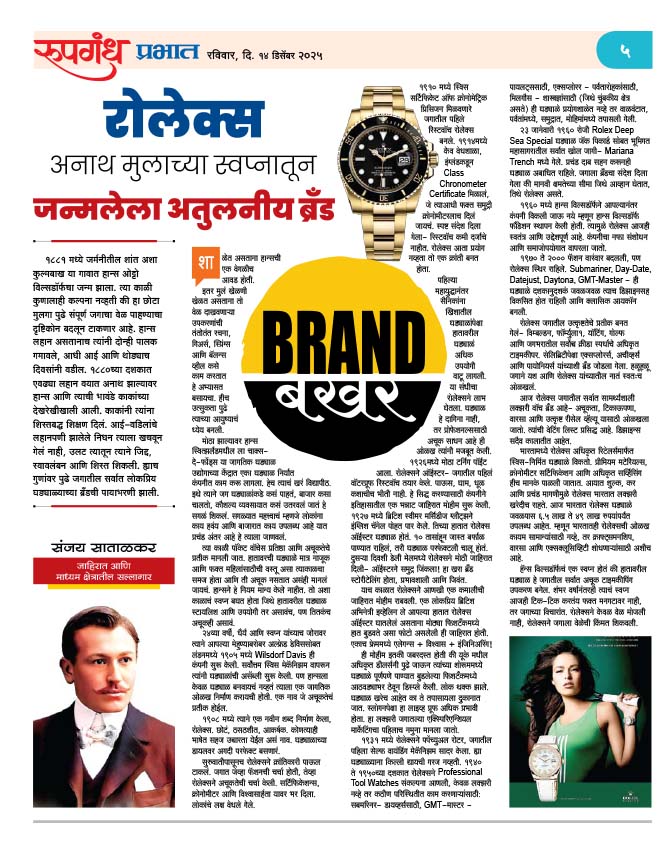
“Rolex” — a remarkable brand born from an orphan boy’s dream
In 1881, in the quiet German town of Kulmbach, Hans Otto Wilsdorf was born. No one imagined that this little boy would one day change the world’s perception of timekeeping. At a very young age, Hans lost both his parents — first his mother, and soon after, his father. In the 1880s, becoming an orphan at such a young age was extremely difficult, but Hans and his siblings were taken in by their uncle, who gave them disciplined schooling. Instead of breaking him, these early hardships taught Hans resilience, independence, and discipline. These very qualities later became the foundation of one of the world’s most iconic watch brands.
Even in school, Hans had an unusual interest. While other children played with toys, he would spend time studying timekeeping devices — their gears, springs, and balance wheels, and how they worked. This curiosity soon became his life’s purpose.
As he grew older, Hans began working in La Chaux-de-Fonds, Switzerland — the global hub of the watchmaking industry. It became his true “university.” Here he learned how the world viewed watches, how the market worked, and how skill could be turned into business. Most importantly, he realised that there was a huge gap between what people wanted and what the market offered.
At that time, pocket watches were considered symbols of prestige and accuracy. Wristwatches were thought to be delicate, meant only for women, and not reliable. Hans refused to accept these “rules.” He dreamt of a future where wristwatches would be stylish, useful, and just as accurate as pocket watches.
At just 24, driven by courage and a dream, he and his brother-in-law Alfred Davis started a company in London in 1905 — Wilsdorf & Davis. They began assembling watches using the best Swiss mechanisms. But Hans didn’t just want to make watches — he wanted to create a global identity, a name that would stand for precision.
In 1908, he coined a completely new word: “Rolex.” Short, bold, memorable, and easy to pronounce in any language. A name that sat perfectly on a watch dial.
From the beginning, Rolex chose a different path. While the world talked about fashion, Rolex talked about accuracy. They focused on certifications, chronometers, and reliability and soon people started noticing.
In 1910, Rolex became the world’s first wristwatch to receive the Swiss Certificate of Chronometric Precision. In 1914, Kew Observatory in England awarded it the Class A Chronometer Certificate — something previously given only to marine chronometers. The message was loud and clear: wristwatches were not inferior. Rolex was no longer an experiment — it was a revolution.
After World War I, soldiers found wristwatches far more practical than pocket watches. Rolex seized this opportunity and strengthened the positioning that watches were not jewellery but precision instruments for professionals.
In 1926 came the defining moment. Rolex created the Oyster — the world’s first waterproof wristwatch. Rain, sweat, dust — nothing could harm it. To prove this, they launched one of history’s most brilliant advertising campaigns. In 1927, British swimmer Mercedes Gleitze swam across the English Channel wearing a Rolex Oyster. After more than 10 hours in freezing water, the watch worked perfectly. The next day, Rolex ran a big advertisement in the Daily Mail: “The Oyster Conquers the Sea!”
This was true brand storytelling powerful and alive.
Around the same time, Rolex ran another striking advertisement featuring a popular British actress, Evelyn Laye, dipping her arm with a Rolex Oyster into a large fish tank. One image that combined elegance, trust, and engineering.
The campaign became so successful that authorised dealers in the UK began displaying watches submerged in fish tanks in their showrooms for an entire week. People were stunned. They would visit the store just to check if the watches were real. This “live proof” was more effective than any slogan — and is considered the world’s first example of experiential marketing in luxury.
In 1931, Rolex introduced the Perpetual Rotor, the world’s first self-winding mechanism no need to wind the watch manually.
In the 1940s and 50s, Rolex created the concept of Professional Tool Watches, designed not just for luxury but for people working in extreme environments:
- Submariner — for divers
- GMT-Master — for pilots
- Explorer — for mountaineers
- Milgauss — for scientists working near magnetic fields
These watches weren’t tested in labs but in deserts, mountains, oceans, and expeditions.
On 23 January 1960, the Rolex Deep Sea Special descended with Jacques Piccard into the Mariana Trench — the deepest point on Earth. Despite immense pressure, the watch remained unharmed. The world understood the brand’s message: “Where human limits are tested, Rolex is present.”
In 1960, Hans Wilsdorf established the Hans Wilsdorf Foundation to ensure the company would never be sold after him. Because of this, Rolex remains independent and purpose-driven even today. Its profits are used for research and social good.
From 1970 to 2000, fashion trends kept changing, but Rolex stayed consistent. The Submariner, Day-Date, Datejust, Daytona, and GMT-Master continued evolving while retaining their classic designs eventually becoming timeless icons.
Rolex became a global symbol of excellence the official timekeeper for Wimbledon, Formula 1, yachting, golf, and other top international sporting events. The brand connected more with explorers, achievers, and pioneers than with celebrities. Gradually, the world itself linked success with Rolex.
Today, Rolex is the world’s most powerful luxury watch brand known for precision, durability, heritage, and exceptional resale value. Their waiting list is famous. Their designs are timeless.
In India, Rolex sells Swiss-made watches through authorised retailers. The standards remain the same — premium materials, chronometer certification, and official servicing. Because of import duties, taxes, and high demand, Rolex remains a luxury purchase in India. Prices range from around ₹6.5 lakh to ₹49 lakh. Naturally, Rolex in India continues to represent craftsmanship, heritage, and exclusivity, rather than mass appeal.
Hans Wilsdorf had one dream that the wristwatch would become the world’s most accurate timekeeping device. Even after a hundred years, his dream continues to tick not just on wrists, but in the world’s imagination. Rolex didn’t just measure time; it taught the world the value of time.
Writer: Sanjay Satalkar
Consultant in Advertising & Marketing