

Nataraj–Apsara
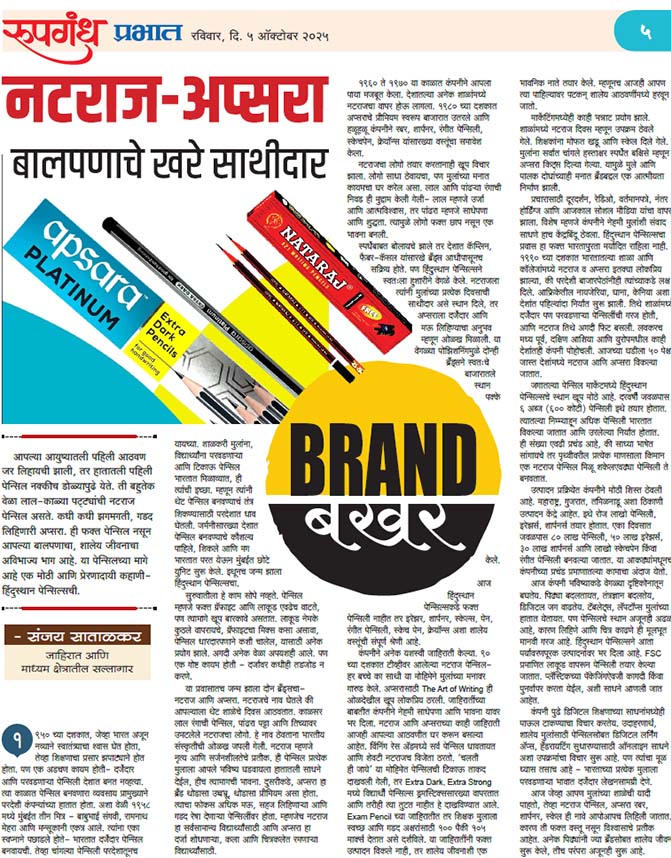
Nataraj–Apsara: The True Companions of Our Childhood
If we try to recall the very first memory of school, the first thing that comes to mind is the pencil in our hand. Most often, it was the red-and-black striped Nataraj pencil, and sometimes the glossy, dark-writing Apsara pencil. These were not just pencils – they were an integral part of our childhood, school life, and identity. Behind these simple pencils lies the inspiring brand story of Hindustan Pencils.
In the 1950s, when India had just breathed the air of freedom, the spread of education was growing rapidly. But there was one big challenge – quality yet affordable pencils were not being manufactured in India. The pencil industry was dominated by foreign brands. In 1958, three visionaries from Mumbai – Babubhai Sanghvi, Ramnath Mehra, and Mansukani – came together with one dream: to build an Indian brand of world-class pencils. To acquire the expertise, they went abroad, studied the German art of pencil-making, and returned to set up a small manufacturing unit in Mumbai. This was the birth of Hindustan Pencils.
The journey was not easy. A pencil looks simple, but behind it lies a science – the right wood, the graphite mix, and the smoothness of sharpening. After many failures and repeated product testing, one principle remained constant – no compromise on quality.
It was during this journey that two iconic brands were born – Nataraj and Apsara. The Nataraj pencil, with its red-and-black stripes and distinctive logo design, immediately struck a chord with Indian students. The brand name “Nataraj” symbolized Indian culture, creativity, and the dance of imagination. It positioned itself as the everyday companion of every child. On the other hand, Apsara was crafted as a more premium brand, offering smoother, darker writing – appealing to those who valued quality, handwriting, and art. Thus, Nataraj was for the masses, and Apsara for the classes.
Through the 1960s and 70s, Hindustan Pencils consolidated its presence. By the 1980s, Apsara had established itself as a premium product line, and the company gradually expanded into erasers, sharpeners, colored pencils, sketch pens, and crayons.
Even in logo branding, careful thought was applied. The Nataraj logo was deliberately kept simple yet memorable. The choice of red stood for energy and confidence, while white represented simplicity and purity. This turned the logo into an emotional symbol rather than just a mark.
The competition was strong – brands like Camlin and Faber-Castell were already in the market. But Hindustan Pencils differentiated itself smartly through brand positioning. Nataraj was positioned as “every child’s daily companion”, while Apsara was marketed as “The Art of Writing”. This clear brand identity helped both lines secure a loyal consumer base.
The company invested in advertising campaigns that became classics. In the 1990s, the TV campaign “Nataraj Pencil – Har Bachhe Ka Saathi” resonated strongly with children and parents alike. For Apsara, the tagline “The Art of Writing” created a strong aspirational pull. Some of the most memorable campaigns include:
- The Winning Race Ad – where pencils run a race, and Nataraj emerges the winner.
- Chalti Hi Jaye – highlighting the durability of Nataraj.
- Extra Dark, Extra Strong – showing students using pencils as drumsticks, yet unbreakable.
- Exam Pencil – where a teacher awards 105 marks out of 100 for clean and dark handwriting.
These ads not only sold products but also built a deep emotional connect with school life. Even today, these campaigns remain etched in our minds, a perfect example of advertising with nostalgia marketing.
The company also explored unique marketing activations. “Nataraj Day” was celebrated in schools. Teachers were gifted chalk and scales. Children participated in handwriting competitions where Apsara kits were given as prizes. These below-the-line (BTL) promotions built strong brand loyalty among students, parents, and teachers.
For brand communication, the company moved with the times – from Doordarshan and print ads to outdoor hoardings, and now to social media. The key focus always remained the same – direct communication with children.
By the 1990s, the popularity of Nataraj and Apsara in Indian schools drew global attention. Exports began to Nigeria, Ghana, and Kenya, where the demand for quality yet affordable pencils was high. Soon, the brand expanded to the Middle East, South Asia, and Europe. Today, Nataraj and Apsara are sold in over 50 countries.
Hindustan Pencils is now one of the world’s largest pencil manufacturers, producing nearly 6 billion pencils annually – enough to give every human being on earth at least one Nataraj pencil. With factories in Maharashtra, Gujarat, and Tamil Nadu, daily production touches 8 million pencils, 5 million erasers, 3 million sharpeners, and millions of sketch pens and crayons.
Looking forward, the company is innovating with sustainability branding. FSC-certified wood is being used, and eco-friendly packaging is replacing plastic. The brand is also exploring the fusion of stationery with digital learning – apps for handwriting improvement and educational tools to complement pencils. Yet, the core mission remains unchanged – to provide every child in India with quality writing instruments at affordable prices.
Even today, when parents prepare a school supply list, the names “Nataraj pencil, Apsara eraser, sharpener, scale” come naturally. These are no longer just stationery items – they are symbols of trust, heritage, and brand legacy. Generations have begun their school journey with these brands, and the tradition continues.
Writer: Sanjay Satalkar
Consultant in Advertising & Marketing