

McDonald’s
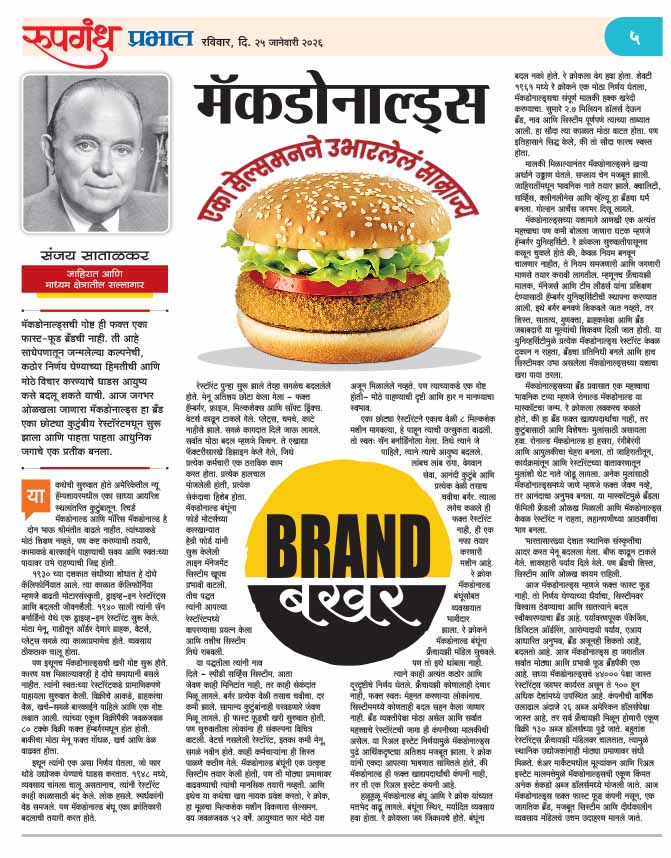
McDonald’s: An Empire Built by a Salesman
The story of McDonald’s is not just the story of a fast-food brand. It is the story of an idea born from simplicity, the courage to take tough decisions, and how the boldness to “think big” can change a life. Today, McDonald’s is a globally recognised brand, but it began as a small family restaurant and gradually became a symbol of the modern world.
This story begins in a simple Irish immigrant family in New Hampshire, USA. Brothers Richard McDonald and Maurice McDonald did not grow up wealthy. They did not have higher education, but they had the willingness to work hard, the habit of observing work closely, and a strong desire to stand on their own feet.
In the 1930s, in search of opportunities, the two brothers moved to California. At that time, California represented a growing car culture, drive-in restaurants, and a changing lifestyle. In 1940, they started a drive-in restaurant in San Bernardino. It had a large menu, customers ordering from their cars, waiters, plates—everything was typical of that era. The business was doing reasonably well.
But this is where the real McDonald’s story begins. Even after achieving success, the brothers were not satisfied. They started honestly analysing their own restaurant—sales figures, customer time, and costs. And they noticed something shocking. Nearly 80 percent of their total sales came from just one item: hamburgers. The rest of the large menu was only increasing confusion, cost, and time.
At this point, they made a decision that very few entrepreneurs have the courage to make. In 1948, even though the business was doing well, they temporarily shut down the restaurant. People laughed at them. Competitors thought they had gone mad. But the McDonald brothers were preparing for a revolutionary change.
When the restaurant reopened, everything had changed. The menu was drastically reduced—only hamburgers, fries, milkshakes, and soft drinks. Waiters were removed. Plates, spoons, and forks disappeared. Food was served in paper wrappers. The biggest change was in the kitchen. It was designed like a factory, where each employee performed a fixed task. Every movement was measured, every second counted. The McDonald brothers were deeply impressed by Henry Ford’s assembly-line system used in Ford Motor factories. They tried to apply the same system to their restaurant—and they succeeded.
They called this method the “Speedee Service System.” Now food was served not in minutes, but in seconds. Burgers tasted the same every single time. Prices were reduced. Ordinary families could afford to eat there. This was the true beginning of fast food.
Initially, however, people found the concept strange. A restaurant without waiters, such a limited menu—everything felt new. Some employees found it difficult to follow such strict discipline. The McDonald brothers had created an excellent system, but they were not mentally prepared to expand it on a very large scale.
And this is where the real hero of the story enters—Ray Kroc, a milkshake machine salesman. He was nearly 52 years old and had not achieved major success in life yet. But he had two powerful qualities: the ability to see big opportunities and a refusal to give up.
When a small restaurant ordered eight milkshake machines at once, his curiosity was triggered. He personally travelled to San Bernardino. What he saw there changed his life—long queues, fast service, happy families, and burgers that tasted exactly the same every time. He immediately realised that this was not just a restaurant, but a money-making machine.
Ray Kroc partnered with the McDonald brothers and suggested the franchise model. But he did not stop there. He made some extremely tough and visionary decisions. Franchises would be given only to hardworking operators, not to investors. No changes to the system would be tolerated. The brand would be bigger than any individual. And most importantly, the restaurant land would be owned by the company. This real estate decision later made McDonald’s financially very strong. Ray Kroc once said in a speech that McDonald’s is not just a food company—it is a real estate company.
Gradually, differences began to grow between the McDonald brothers and Ray Kroc. The brothers wanted a stable, limited business. Ray Kroc wanted to conquer the world. The brothers resisted change. Ray Kroc wanted speed. Finally, in 1961, Ray Kroc made a bold decision—to buy complete ownership of McDonald’s. For about 2.7 million dollars, the brand, name, and system came fully under his control. At the time, it seemed like a big deal. History later proved it was actually very cheap.
After gaining ownership, McDonald’s truly took off. The supply chain was strengthened. Advertising created an emotional connection. “Quality, Service, Cleanliness, and Value” became the brand’s core belief. The Golden Arches began appearing all over the world.
One extremely important but less talked-about factor behind McDonald’s success is “Hamburger University.” Ray Kroc understood early on that rules alone are not enough—you need people who understand and live by those rules. So Hamburger University was established to train franchise owners, managers, and team leaders. It did not just teach how to make burgers; it taught discipline, consistency, quality, customer service, and brand responsibility. Because of this university, every McDonald’s restaurant became not just a shop, but a true representative of the brand. This system-based approach became the real foundation of McDonald’s success.
Another important emotional milestone in McDonald’s brand journey was the birth of the mascot Ronald McDonald. Ray Kroc realised that the brand should not be only about food, but about families—and especially children. Ronald McDonald became a cheerful, colourful, and friendly face. Through advertisements, events, and the restaurant atmosphere, he connected directly with children. For many kids, visiting McDonald’s became not just about eating food, but about happiness and fun. This mascot gave the brand a “family-friendly” identity and turned McDonald’s into a part of childhood memories.
In countries like India, the menu was adapted to respect local culture. Beef was removed. Vegetarian options were introduced. But the brand’s discipline, system, and identity remained unchanged.
Today, McDonald’s is not just fast food. It represents the courage to take decisions, trust in systems, and continuously adapt to change. With eco-friendly packaging, digital ordering, healthier options, and AI-based experiences, the brand is still learning and evolving.
Today, McDonald’s is one of the world’s largest and most influential food brands. More than 44,000 McDonald’s restaurants are operating globally across over 100 countries. The company’s annual revenue is estimated at over 26 billion US dollars, while total system-wide sales from all franchises exceed 130 billion dollars. Most restaurants operate on the franchise model, creating large-scale opportunities for local entrepreneurs. Due to its stock market valuation and real estate assets, McDonald’s overall value is estimated in the hundreds of billions of dollars. Today, McDonald’s is not just a fast-food company, but a global brand, a powerful system, and a strong example of a long-term business model.
Writer: Sanjay Satalkar
Consultant in Advertising & Marketing