

Continental Coffee
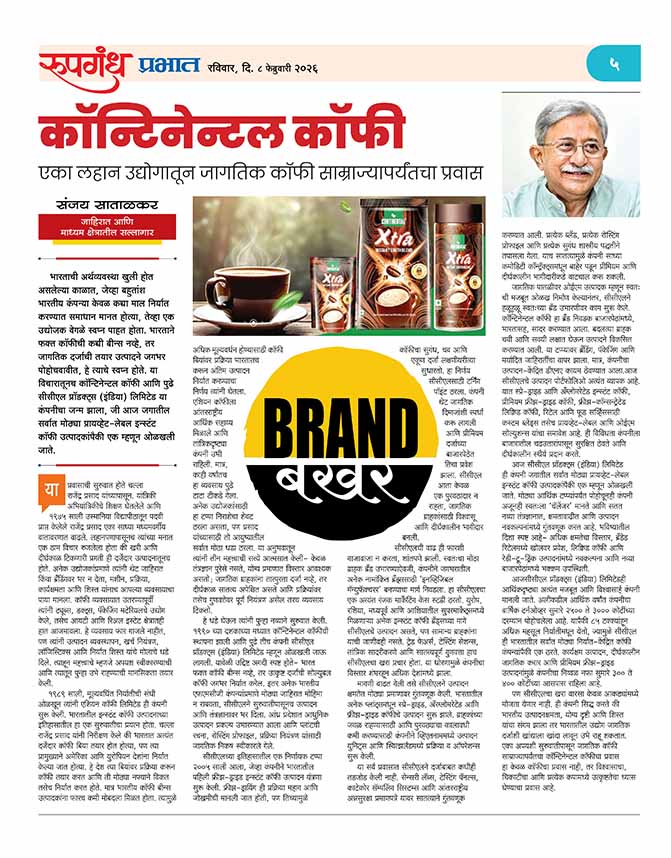
Continental Coffee – The Journey from a Small Enterprise to a Global Coffee Empire
At a time when India’s economy was opening up and most Indian companies were satisfied with exporting only raw materials, one entrepreneur was dreaming differently. His dream was that India should not just export raw coffee beans, but deliver world-class finished coffee products to global markets. From this vision was born Continental Coffee and later CCL Products (India) Limited, a company that is today recognized as one of the world’s largest private-label instant coffee manufacturers.
This journey begins with Challa Rajendra Prasad. A mechanical engineer by education, he graduated from Osmania University in 1975 and grew up in a simple middle-class environment. From a young age, he strongly believed that real and long-term progress comes only from quality products. Unlike many entrepreneurs, he did not focus on advertising or branding in the early stages. Instead, he built his business foundation on machines, processes, efficiency, and discipline. Before entering the coffee business, he worked in industries such as tubes, ducts, packaging materials, and also explored IT and real estate. These ventures were not highly successful, but they taught him valuable lessons in production management, cost control, logistics, and export discipline. More importantly, they helped him develop the mindset to accept failure and stand up again.
In 1989, recognizing the opportunity in value-added exports, he started Asian Coffee Limited. This was one of the early attempts in India’s instant coffee manufacturing history. Rajendra Prasad observed that India produced excellent quality coffee beans, but most of them were exported to the US and Europe. Those countries processed the beans, sold the coffee at high margins, and even re-exported it, while Indian coffee producers received very low returns. To create higher value, he decided that coffee processing should be done in India itself and the finished product should be exported. Asian Coffee received international financial support and was technically sound, but within a few years, the business moved to Tata Tea. For many entrepreneurs, this would have been the end of the road. For Rajendra Prasad, it became the biggest lesson of his life. From this experience, he absorbed three key truths—technology alone is not enough; the right scale of operations is essential; global customers expect consistency over the long term, not temporary quality; and a business can survive only when there is complete control over processes and quality.
With these lessons, he started again. In the mid-1990s, Continental Coffee was established, which later became known as CCL Products (India) Limited. This time, the objective was very clear—India would export not just coffee beans, but high-quality soluble coffee to the world. Unlike many Indian FMCG companies, CCL avoided large advertising campaigns and focused entirely on production and technology from day one. A modern manufacturing facility was set up in Andhra Pradesh, and global standards were adopted for plant design, roasting profiles, and process controls.
A defining moment in CCL’s history came in 2005, when the company launched India’s first freeze-dried instant coffee manufacturing facility. Freeze-drying was considered expensive and risky, but it significantly enhances coffee aroma, taste, and overall quality. This decision became a major turning point for CCL. The company began competing directly with global giants and entered the premium coffee segment. CCL was no longer just a supplier; it became a trusted, long-term partner for global customers.
CCL’s growth happened quietly, without much publicity. Instead of building a large consumer brand, the company chose to become an “invisible manufacturer” for many leading global brands. This makes CCL a fascinating marketing case study. Many instant coffee brands found in supermarkets across Europe, Russia, the Middle East, and Asia are actually manufactured by CCL, though consumers are usually unaware of it. Trade fairs, tasting sessions, technical presentations, and consistent quality became CCL’s real marketing tools. This strategy helped the company expand to more than 100 countries.
As demand grew, CCL invested heavily in expanding its manufacturing capacity. Multiple plants in India began producing spray-dried, agglomerated, and freeze-dried coffee. To stay closer to customers and reduce delivery time, the company set up manufacturing units in Vietnam and processing and operations facilities in Switzerland.
Throughout this journey, CCL never compromised on quality. Continuous investments were made in sensory labs, testing panels, strict sampling systems, and international food safety certifications. Every blend, every roasting profile, and every aroma was scientifically tested. This consistency helped the company move away from low-margin commodity contracts toward premium and long-term partnerships.
After establishing a strong global identity as an OEM manufacturer, CCL gradually started working on building its own brands. The Continental Coffee brand was introduced in select markets, including India. Products were developed by keeping changing consumer tastes and habits in mind. At this stage, branding, packaging, and limited advertising were used, while the company’s production-focused DNA remained intact.
Today, CCL’s product portfolio is extremely diverse. It includes spray dried and agglomerated instant coffee, premium freeze-dried coffee, freeze concentrated liquid coffee, custom blends for retail and foodservice, as well as private label and OEM solutions. This diversity protects the company from market fluctuations and provides long-term stability.
Today, CCL Products (India) Limited is recognized as one of the world’s largest private-label instant coffee manufacturers. Despite achieving major financial milestones, the company still considers itself a “challenger” and continues to invest in new technologies, capacity expansion, and product innovation. Its future direction is clear—greater capacity expansion, deeper entry into branded retail, innovation in liquid coffee and ready-to-drink products, and a strong presence in new global markets.
Financially, CCL Products (India) Limited is considered a very strong and reliable company. In recent financial years, its annual turnover has reached approximately ₹2,500 to ₹3,000 crore. More than 85% of its revenue comes from exports, making CCL one of India’s most export-focused coffee companies. Efficient manufacturing, long-term global contracts, and premium freeze-dried products have helped the company maintain a net profit of around ₹300 to ₹400 crore.
However, CCL’s true legacy cannot be measured only in numbers. The company proves that when Indian manufacturing capability is combined with the right vision and discipline, Indian businesses can stand shoulder to shoulder with global leaders. Continental Coffee’s journey from a failed beginning to a global coffee empire is not just a story about coffee. It is a journey of trust, perseverance, and a relentless pursuit of excellence in every cup.
Writer: Sanjay Satalkar
Consultant in Advertising & Marketing