

Camlin
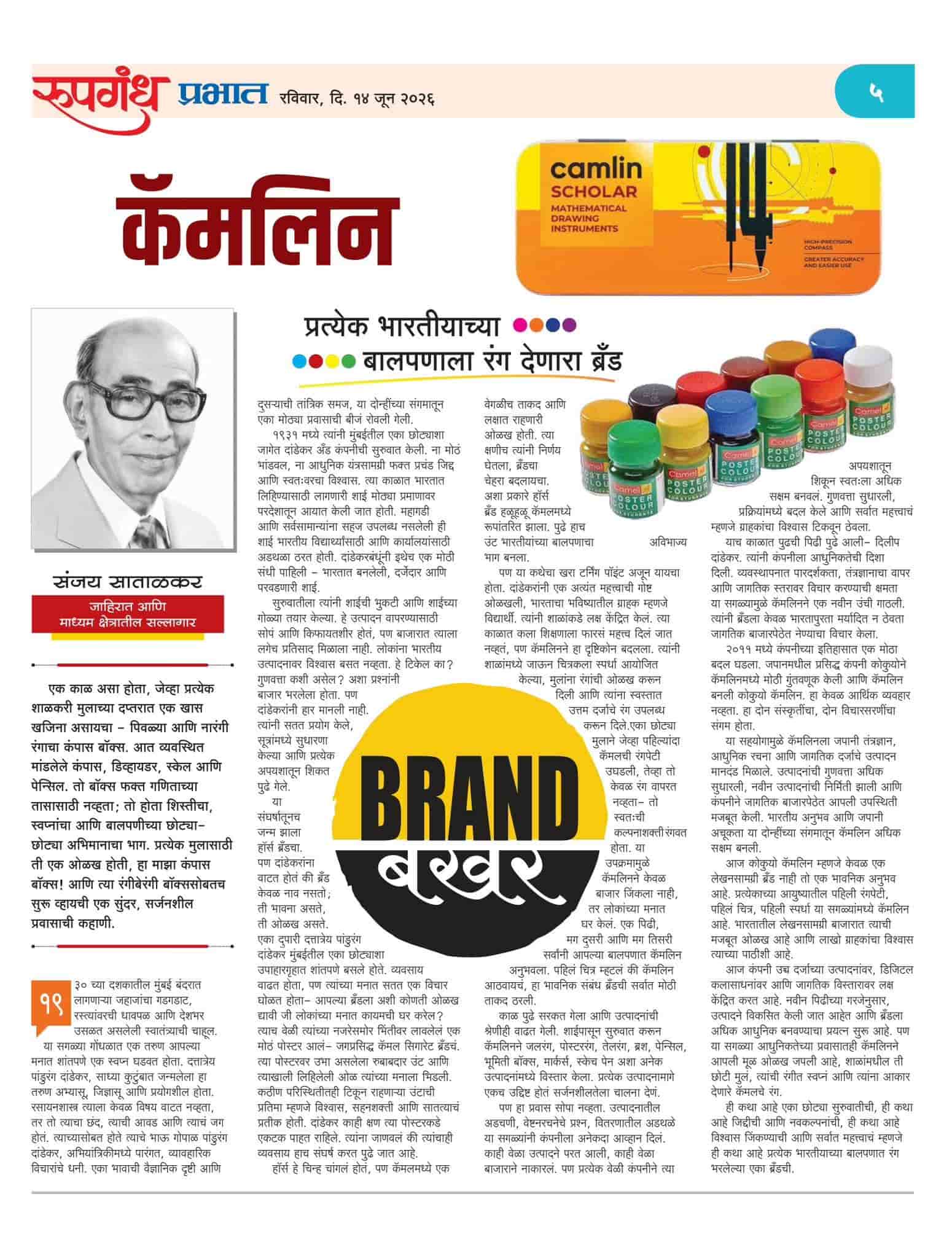
Camlin: The Brand That Added Colours to Every Indian Childhood
There was a time when every school child carried a special treasure in their school bag a yellow and orange compass box. Inside, everything was neatly arranged: a compass, divider, scale, and pencils. That box was not just for mathematics class it was a symbol of discipline, dreams, and the small joys of childhood pride. Every child proudly said, “This is my compass box!” And with that colourful box began a beautiful journey of creativity.
Mumbai in the 1930s… the loud sounds of ships at the port, busy streets full of activity, and the growing spirit of India’s freedom movement. Amidst all this, a young man was quietly building a dream in his mind Dattatraya Pandurang Dandekar. Born into a simple family, he was intelligent, curious, and experimental by nature. Chemistry was not just a subject for him; it was his passion, his hobby, his world. Supporting him was his brother, Gopal Pandurang Dandekar skilled in engineering and practical thinking. The scientific vision of one brother and the technical understanding of the other laid the foundation for a remarkable journey.
In 1931, they started “Dandekar & Company” in a small space in Mumbai. They had neither huge capital nor modern machinery only determination and self-belief. At that time, ink used for writing in India was largely imported from foreign countries. It was expensive and not easily affordable for ordinary students and offices. The Dandekar brothers saw a big opportunity here “high-quality, affordable ink made in India.”
Initially, they manufactured ink powder and tablets. These products were easy to use and economical, but the market did not accept them immediately. People did not trust Indian-made products. Questions like “Will it last?” and “How good will the quality be?” filled the market. But the Dandekars did not give up. They kept experimenting, improving formulas, and learning from every failure.
Out of this struggle was born the “Horse Brand.” But the Dandekars believed that a brand was not just a name it was an emotion, an identity. One afternoon, Dattatraya Pandurang Dandekar was sitting quietly in a small restaurant in Mumbai. His business was growing, but one thought kept troubling him “What kind of identity should our brand have so that people will remember it forever?” At that moment, his eyes fell on a large poster on the wall the world-famous “Camel” cigarette brand. The stylish camel standing on the poster and the message below it deeply impressed him. The camel represented trust, endurance, and consistency even in difficult conditions. Dandekar stared at the poster for a few moments. He realized that his own business was also surviving through struggle and persistence. The “Horse” symbol was good, but “Camel” had a stronger and more memorable identity. At that very moment, he decided to change the face of the brand. And thus, “Horse Brand” slowly transformed into “Camel.” Later, this camel became an inseparable part of Indian childhood.
But the real turning point in this story was yet to come. The Dandekars understood one very important thing the future customers of India would be students. They focused on schools. At that time, art education was not given much importance, but Camlin changed this thinking. The company organized drawing competitions in schools, introduced children to colours, and made good-quality colours available at affordable prices. When a small child opened a Camel colour box for the first time, he was not just using colours he was painting his imagination.
Because of these efforts, Camlin did not just win the market it won people’s hearts. One generation, then another, and then a third everyone experienced Camlin during their childhood. Whenever people remembered their “first drawing,” they remembered Camlin. This emotional connection became the brand’s greatest strength.
As time moved forward, the product range also expanded. Starting with ink, Camlin entered many categories such as watercolours, poster colours, oil colours, brushes, pencils, geometry boxes, markers, and sketch pens. Behind every product was one clear objective “to encourage creativity.”
But the journey was not easy. Manufacturing difficulties, packaging problems, and distribution challenges tested the company many times. Sometimes products were returned, and sometimes the market rejected them. But every failure became a lesson. The company improved quality, changed processes, and most importantly, maintained customer trust.
During this period, the next generation stepped forward Dilip Dandekar. He gave the company a modern direction. Transparency in management, use of technology, and the ability to think globally helped Camlin achieve new heights. He wanted the brand not to remain limited to India, but to reach international markets.
In 2011, a major change took place in the company’s history. Japan’s famous company Kokuyo made a major investment in Camlin, and “Camlin” became “Kokuyo Camlin.” This was not just a financial deal it was a meeting of two cultures and two ways of thinking.
Through this collaboration, Camlin gained Japanese technology, modern design, and world-class production standards. Product quality improved further, new products were developed, and the company strengthened its presence in global markets. The combination of Indian experience and Japanese precision made Camlin even stronger.
Today, “Kokuyo Camlin” is not just a stationery brand it is an emotional experience. Everyone’s first colour box, first drawing, and first competition has Camlin connected to it in some way. The brand has a strong identity in India’s stationery market and enjoys the trust of millions of customers.
Today, the company is focusing on premium products, digital art tools, and global expansion. Products are being developed according to the needs of the new generation, and efforts are being made to make the brand more modern. Yet, even in this journey of modernization, Camlin has preserved its original identity those little children in schools, their colourful dreams, and the Camel colours that helped shape them.
This is the story of a small beginning.
This is the story of determination and innovation.
This is the story of winning people’s trust.
And most importantly this is the story of a brand that filled every Indian childhood with colors.
Author: Sanjay Satalkar
Advertising and Marketing Consultant