

Atomberg
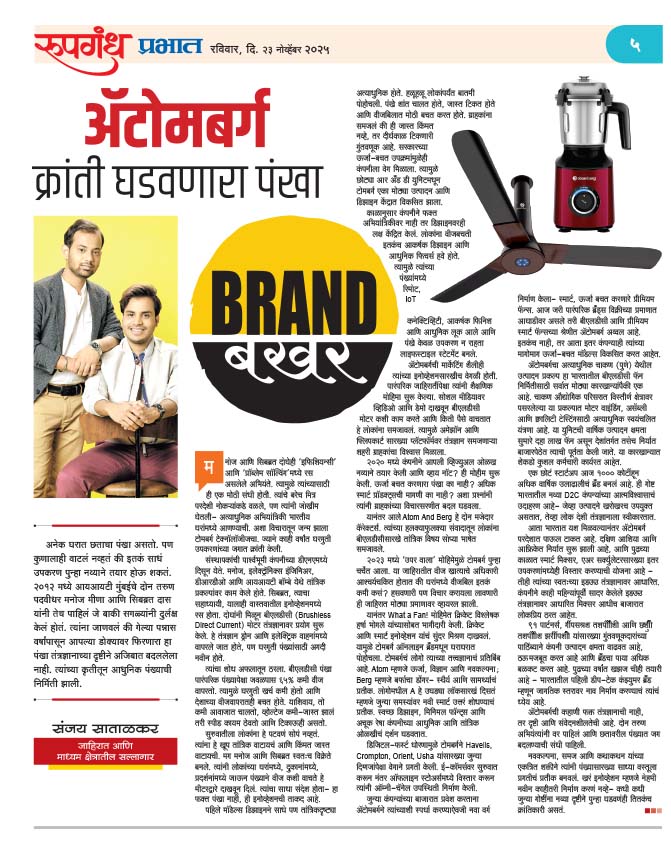
Atomberg – The Fan That Sparked a Revolution
Almost every home in India has a ceiling fan. But no one ever imagined that such a simple device could be reinvented. In 2012, two young IIT Bombay graduates Manoj Meena and Sibabrata Das noticed what everyone else had ignored. They realized that the fan spinning above India’s head for the last fifty years had hardly changed technologically.
Both Manoj and Sibabrata were engineers deeply interested in efficiency and problem-solving. For them, this was a big opportunity. While many of their friends moved abroad for jobs, they took a risk to bring cutting-edge engineering into Indian households. That thought gave birth to Atomberg Technologies, a company that transformed the home appliances industry within a few years.
The founders’ background is clearly reflected in the company’s DNA. Manoj, an electronics engineer, had worked on technical projects with DRDO and IIT Bombay. His collegemate Sibabrata was equally passionate about real-world innovation. Together they began experimenting with BLDC (Brushless Direct Current) motor technology used in drones and electric vehicles but completely new for ceiling fans.
Their discovery was extraordinary. A BLDC fan consumes nearly 65% less electricity than a traditional fan. This not only reduces household expenses but also saves national power. Additionally, the fan runs quietly, maintains speed even under fluctuating voltage, and is far more durable.
Convincing people in the beginning wasn’t easy. The technology felt too complex, and the price seemed high. So Manoj and Sibabrata became salesmen themselves. They went to homes, shops, and exhibitions, demonstrating power savings through a meter. Their message was simple “This is not just a fan; it is the power of innovation.”
The early models were simple in design but technologically advanced. Slowly, word spread. The fans ran silently, lasted longer, and significantly reduced electricity bills. Customers realized this wasn’t an expensive product but a long-term investment. Government energy-saving initiatives further boosted the company. What began as a small R&D unit soon grew into a major manufacturing and design powerhouse.
Over time, the company focused not only on engineering but also on design. Consumers wanted stylish looks and modern features along with energy savings. So Atomberg introduced fans with remotes, IoT connectivity, sleek finishes, and contemporary aesthetics transforming fans from mere appliances to lifestyle statements.
Atomberg’s marketing was as innovative as its technology. Instead of traditional advertising, it launched educational campaigns. Through videos and demos on social media, it explained how BLDC technology works and how much money it saves. This helped build trust among tech-savvy urban customers on Amazon and Flipkart.
In 2020, the company refreshed its visual identity and launched the “Why Not?” campaign — “Why not an energy-saving fan?”, “Why not demand smarter products?” These questions challenged consumer mindsets.
Then came two fun characters Atom & Berg who explained technical concepts like BLDC motors in simple, light-hearted conversations.
In 2023, Atomberg again became the talk of the town with its “Upar Wala” campaign, where electricity department officers are puzzled at how households have such low power bills. Humorous yet thought-provoking, the ad went viral.
The “What a Fan!” campaign followed, featuring cricket analyst Harsha Bhogle, blending cricket with smart innovation. This helped Atomberg shift from being primarily an online brand to a household name.
Atomberg’s logo reflects its philosophy. “Atom” represents energy, science, and innovation; “Berg” signifies an iceberg symbolizing stability and strength. The ‘A’ in the logo resembles an open lock representing smart solutions to old problems. The clean design, minimal fonts, and precise lines mirror the company’s modern, tech-oriented identity.
With a digital-first strategy, Atomberg grew faster than established giants like Havells, Crompton, Orient, and Usha. Starting on e-commerce and later expanding to offline stores, it built a strong omni-channel presence.
Entering markets dominated by old players, Atomberg didn’t try to compete directly. Instead, it created a new category smart, energy-efficient premium fans. Today, while traditional brands may still lead in overall volume, Atomberg is the leader in BLDC and premium smart fans. Other companies are now following its path, launching energy-efficient models.
Atomberg’s state-of-the-art manufacturing plant in Chakan (Pune) is one of India’s largest BLDC fan production facilities. Spread across a vast industrial area, it houses advanced automated systems for motor winding, assembly, and quality testing. The unit has an annual capacity of nearly one million fans, serving both domestic and export markets. Hundreds of skilled employees work there.
What started as a small startup has today become a brand with over ₹1000 crore in annual revenue. It represents the confidence of India’s new D2C companies proof that when products are genuinely useful, consumers wholeheartedly embrace homegrown technology.
After succeeding in India, Atomberg is now expanding overseas. Exports to South Asia and Africa have begun. Plans are underway to enter other appliance categories like smart mixers and air circulators, all powered by its own BLDC technology. Mixers launched recently have already become popular.
With support from investors like A91 Partners, Jungle Ventures, and Nexus Venture Partners, the company is increasing production capacity, strengthening R&D, and building a stronger brand foundation. An IPO is planned in the coming years aiming to become India’s first deep-tech consumer brand recognized globally.
The story of Atomberg is not just about technology; it is about vision and sensitivity. Two young engineers looked up, saw an ordinary ceiling fan, and found a chance to change the world.
Through innovation, insight, and storytelling, they turned a simple household object into a symbol of progress. True innovation isn’t always about creating something new sometimes, reimagining the old with fresh eyes can be equally revolutionary.
— Written by Sanjay Satalkar
Consultant in Advertising and Marketing