

Duckback
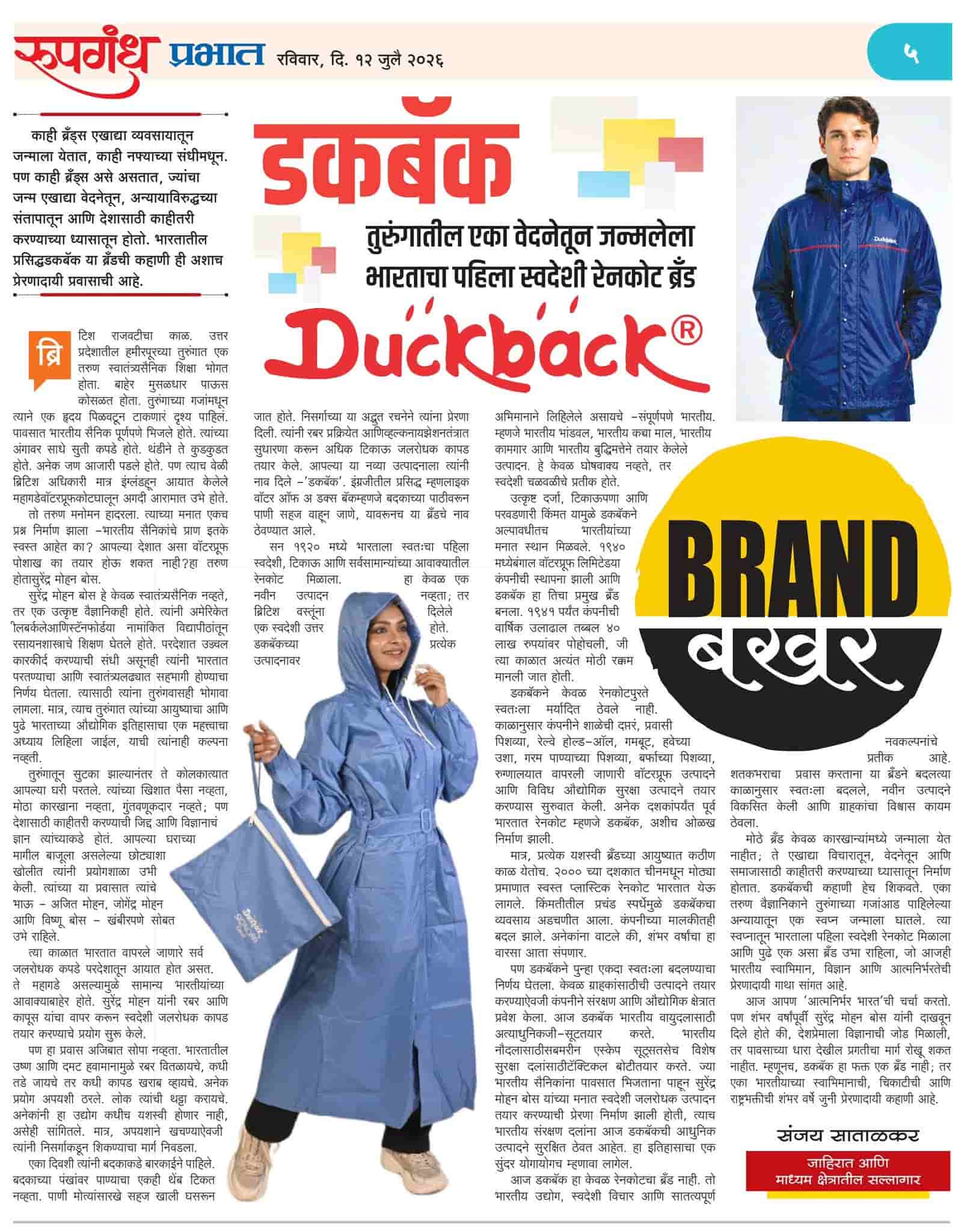
Duckback – India’s First Indigenous Raincoat Brand Born from Pain Behind Prison Bars
Some brands are born out of business opportunities. Some are created to make profits. But a few brands are born from pain, anger against injustice, and a deep desire to serve the nation. The story of Duckback, one of India’s most iconic brands, is one such inspiring journey.
It was the time of British rule. In the prison of Hamirpur in Uttar Pradesh, a young freedom fighter was serving his sentence. Outside, heavy rain was pouring relentlessly. Through the prison bars, he witnessed a heartbreaking sight. Indian soldiers were completely drenched in the rain. They wore only simple cotton uniforms and shivered in the cold. Many of them fell ill. At the same time, British officers stood comfortably wearing expensive waterproof coats imported from England. The young man was deeply disturbed. One question kept troubling him: “Are the lives of Indian soldiers so cheap? Why can’t India make its own waterproof clothing?” That young man was Surendra Mohan Bose.
Surendra Mohan Bose was not only a freedom fighter but also an accomplished scientist. He had studied Chemistry at the prestigious University of California, Berkeley and Stanford University in the United States. Although he had the opportunity to build a successful career abroad, he chose to return to India and join the freedom movement. That decision led to his imprisonment. Little did he know that those days in prison would inspire a chapter that would later become an important part of India’s industrial history.
After his release, he returned to his home in Kolkata. He had no money, no factory, and no investors. What he did have was scientific knowledge and an unwavering determination to do something meaningful for his country. He converted a small room behind his house into a laboratory. His brothers Ajit Mohan Bose, Jogendra Mohan Bose, and Vishnu Bose stood firmly by his side throughout this journey.
At that time, all waterproof clothing used in India was imported from foreign countries. It was expensive and beyond the reach of ordinary Indians. Surendra Mohan Bose began experimenting with rubber and cotton to develop an indigenous waterproof fabric.
The journey was far from easy. India’s hot and humid climate created many challenges. Sometimes the rubber melted, sometimes it cracked, and at other times the fabric got damaged. Experiment after experiment failed. People laughed at him, and many believed his venture would never succeed. But instead of giving up, he decided to learn from nature.
One day, he carefully observed a duck. He noticed that not a single drop of water stayed on its feathers. Water simply rolled off like pearls. This remarkable natural design inspired him. He improved the rubber processing and vulcanization techniques, eventually creating a stronger and more durable waterproof fabric.
He named his invention Duckback, inspired by the famous English expression, “Like water off a duck’s back,” which describes how water effortlessly slides off a duck’s feathers.
In 1920, India got its first indigenous, durable, and affordable raincoat. It was much more than a new product—it was India’s Swadeshi answer to British imports. Every Duckback product proudly carried the words “Entirely Indian,” meaning it was made using Indian capital, Indian raw materials, Indian workers, and Indian intelligence. It was not merely a slogan but a symbol of the Swadeshi movement.
Thanks to its excellent quality, durability, and affordable pricing, Duckback quickly won the trust of Indian consumers. In 1940, Bengal Waterproof Limited was established, and Duckback became its flagship brand. By 1941, the company’s annual turnover had reached an impressive ₹40 lakh, a huge amount in those days.
Duckback did not limit itself to raincoats. Over the years, the company expanded into manufacturing school bags, travel bags, railway hold-alls, gumboots, air pillows, hot water bags, ice bags, waterproof hospital products, and various industrial safety products. For several decades, especially in Eastern India, the word raincoat became almost synonymous with Duckback.
Like every successful brand, Duckback also faced difficult times. During the 2000s, cheap plastic raincoats imported from China flooded the Indian market. Fierce price competition affected the company’s business, and ownership changed hands. Many believed that the century-old brand would eventually disappear.
But Duckback reinvented itself once again. Instead of focusing only on consumer products, the company entered the defence and industrial sectors. Today, Duckback manufactures advanced G-suits for the Indian Air Force, submarine escape suits for the Indian Navy, and tactical boats for India’s special security forces.
There is a beautiful irony in this journey. The very sight of Indian soldiers getting drenched in the rain had inspired Surendra Mohan Bose to create an indigenous waterproof product. Today, Duckback’s advanced products are helping protect the very Indian defence forces that inspired its creation.
Today, Duckback is much more than a raincoat brand. It is a symbol of Indian industry, the Swadeshi spirit, and continuous innovation. Over the last hundred years, the brand has evolved with changing times, developed new products, and continued to earn the trust of its customers.
Great brands are not born only inside factories. They are born from ideas, from pain, and from a determination to make a difference in society. Duckback’s story proves exactly that. A young scientist saw injustice through the bars of a prison cell, and that painful moment gave birth to a dream. That dream gave India its first indigenous raincoat and eventually created a brand that continues to represent Indian pride, scientific innovation, and self-reliance.
Today, we often speak about Atmanirbhar Bharat (Self-Reliant India). But more than a hundred years ago, Surendra Mohan Bose had already demonstrated that when patriotism is combined with science and innovation, even the heaviest rains cannot stop a nation’s progress. That is why Duckback is not just a brand. It is a century-old story of Indian pride, determination, innovation, and patriotism.
Author: Sanjay Satalkar
Advertising and Marketing Consultant