

Sony
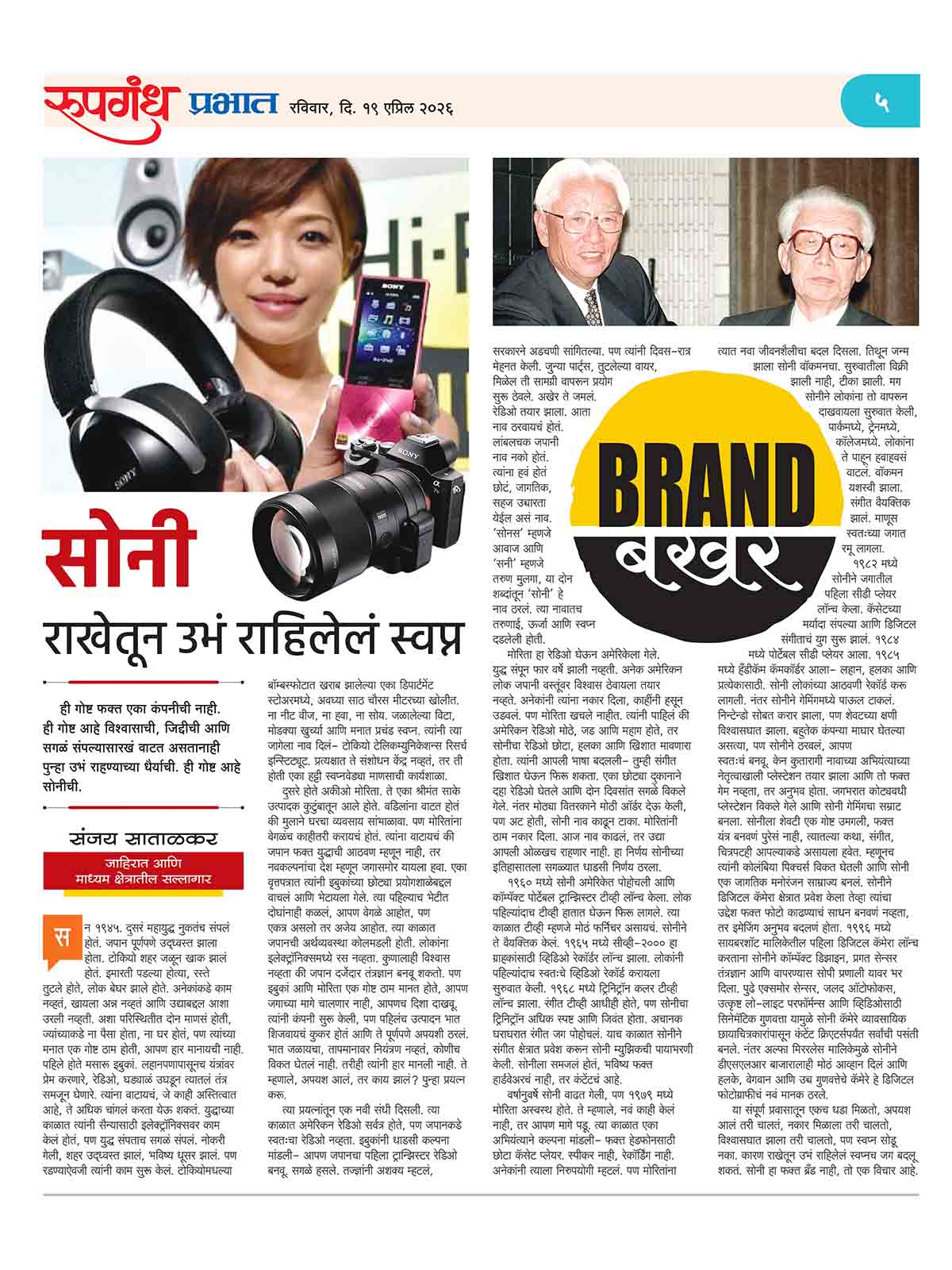
Sony: A Dream That Rose from the Ashes
This is not just the story of one company. It is a story of belief, determination, and the courage to rise again even when everything seems lost. This is the story of Sony.
The year was 1945. World War II had just ended. Japan was completely destroyed. Tokyo was burned down. Buildings had collapsed, roads were broken, people were homeless. Many had no jobs, no food, and no hope for the future. In such a situation, there were two men who had no money, no home, but one strong belief — they would not give up.
The first was Masaru Ibuka. From childhood, he loved machines. He would open radios and clocks to understand how they worked. He believed, “Whatever exists can be made better.” During the war, he worked on electronics for the military. But after the war, everything ended. He lost his job, the city was destroyed, and the future looked uncertain. Instead of giving up, he started working again. In a bomb-damaged department store in Tokyo, in a small 60-square-meter room, with no proper electricity or facilities. Broken bricks, damaged chairs, but a big dream in his heart. He named the place “Tokyo Telecommunications Research Institute.” In reality, it was not a research institute but the workshop of a determined dreamer.
The second was Akio Morita. He came from a wealthy family that made sake. His father wanted him to take over the family business. But Morita wanted to do something different. He believed Japan should be known not just for war, but for innovation. One day, he read about Ibuka’s small lab in a newspaper and went to meet him. In their first meeting itself, both realized — they were different, but together they could be unstoppable.
At that time, Japan’s economy had collapsed. People were not interested in electronics. No one believed Japan could make quality technology. But Ibuka and Morita strongly believed — they would not follow the world, they would lead it. They started a company, but their first product was a rice cooker, and it failed badly. The rice would burn, temperature control was poor, and no one bought it. Still, they did not give up. They said, “So what if we failed? We will try again.”
From these attempts, a new opportunity appeared. At that time, American radios were everywhere, but Japan had none of its own. Ibuka had a bold idea — to make Japan’s first transistor radio. People laughed. Experts said it was impossible, the government raised difficulties. But they worked day and night. Using old parts, broken wires, whatever material they could find, they kept experimenting. Finally, they succeeded. The radio was ready.
Now they needed a name. They did not want a long Japanese name. They wanted something short, global, and easy to pronounce. From the words “sonus” (sound) and “sonny” (young boy), the name “Sony” was created. The name itself carried youth, energy, and dreams.
Morita took this radio to America. Not many years had passed since the war. Many Americans did not trust Japanese products. Many rejected him, some laughed at him. But Morita did not give up. He observed that American radios were big, heavy, and expensive, while Sony’s radio was small, light, and pocket-sized. He changed his message — “You can carry music in your pocket.” A small shop ordered ten radios, and all were sold in two days. Later, a big distributor offered a large order, but with one condition — remove the Sony name. Morita refused firmly. “If we remove our name today, we will lose our identity tomorrow.” This became one of the boldest decisions in Sony’s history.
In 1960, Sony entered America and launched a compact portable transistor TV. For the first time, people could carry a TV. Earlier, TVs were like big furniture. Sony made it personal. In 1965, the CV-2000 video recorder was launched for consumers. People could now record their own videos. In 1968, the Trinitron color TV was launched. Color TVs existed before, but Sony’s was clearer and more vivid. Suddenly, colorful visuals entered homes. Around this time, Sony also entered the music industry and laid the foundation of Sony Music. They understood that the future was not just hardware, but also content.
Over the years, Sony kept growing. But in 1979, Morita felt restless. He said, “If we don’t create something new, we will fall behind.” An engineer suggested a small cassette player only for headphones — no speakers, no recording. Many called it useless. But Morita saw a lifestyle change in it. This led to the birth of the Walkman. Initially, sales were low and there was criticism. Then Sony started demonstrating it in parks, trains, and colleges. People liked it. The Walkman became a success. Music became personal. People entered their own world.
In 1982, Sony launched the world’s first CD player. The limitations of cassettes ended, and the era of digital music began. In 1984, the portable CD player came. In 1985, the Handycam camcorder was launched — small, light, and for everyone. Sony started capturing people’s memories.
Later, Sony entered gaming. They had a deal with Nintendo, but it was broken at the last moment. Most companies would have stepped back, but Sony decided to build their own system. Under engineer Ken Kutaragi, the PlayStation was created. It was not just a game, but an experience. Millions of units were sold worldwide, and Sony became a leader in gaming.
Eventually, Sony realized that making devices alone was not enough — they also needed stories, music, and movies. So they acquired Columbia Pictures and became a global entertainment company. When Sony entered digital cameras, their goal was not just to create a camera, but to change the “imaging experience.” In 1996, they launched the first Cyber-shot digital camera with compact design, advanced sensors, and easy usability. Later, technologies like Exmor sensors, fast autofocus, excellent low-light performance, and cinematic video quality made Sony cameras popular among professionals and content creators. With the Alpha mirrorless series, Sony challenged the DSLR market and set new standards for lightweight, fast, and high-quality photography.
From this entire journey, one lesson stands clear — failure is okay, rejection is okay, even betrayal is okay, but never give up on your dreams. Because only a dream that rises from ashes can change the world. Sony is not just a brand, it is an idea.
Author: Sanjay Satalkar
Advertising and Marketing Consultant