

Thums Up
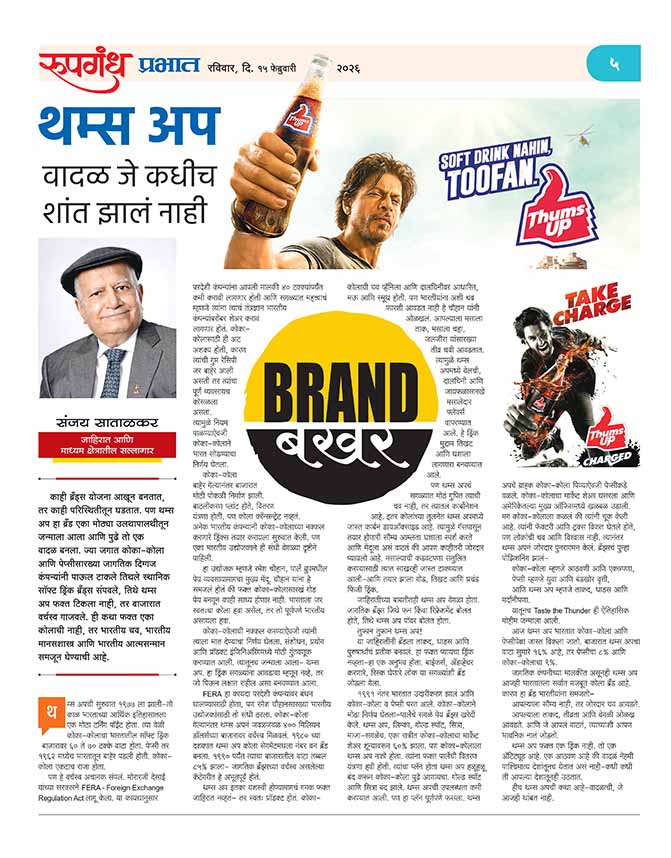
Thums Up: The Storm That Never Calmed Down
Some brands are created through careful planning, while others are born out of circumstances. But Thums Up was born out of a massive upheaval—and later turned into a storm. In a world where global giants like Coca-Cola and Pepsi wiped out local soft drink brands wherever they entered, Thums Up not only survived but dominated the market. This is not just the story of a cola; it is about understanding Indian taste, Indian psychology, and Indian self-respect.
Thums Up began in 1977—a major turning point in India’s economic history. At that time, Coca-Cola held 60 to 70 percent of India’s soft drink market. Pepsi had already exited India in 1962. Coca-Cola was the undisputed king.
But this dominance ended suddenly. The government of Morarji Desai implemented FERA – the Foreign Exchange Regulation Act. Under this law, foreign companies had to reduce their ownership to 40 percent, and most importantly, they had to share their technology with Indian companies. For Coca-Cola, this was impossible. If their secret recipe had been revealed, their entire business could have collapsed. So instead of complying, Coca-Cola chose to leave India..
After Coca-Cola exited, a huge vacuum was created in the market. There were bottling plants and distribution systems, but no cola concentrate. Many Indian companies began producing imitation cola drinks. But one Indian entrepreneur saw this opportunity differently.
That entrepreneur was Ramesh Chauhan, the driving force behind the beverages business of the Parle Group. Chauhan understood that simply making a sweeter drink like Coca-Cola would not achieve much. If India wanted its own cola, it had to be truly Indian.
Instead of copying Coca-Cola, he decided to beat it. Heavy investment was made in research, experiments, and product engineering. And from this effort was born Thums Up. It was not created just to be liked by everyone—it was made to be unforgettable.
FERA was meant to restrict foreign companies, but for Indian entrepreneurs like Ramesh Chauhan, it became an opportunity. After Coca-Cola left, Thums Up captured control of a market worth nearly 400 million dollars. During the 1980s, Thums Up became the number one brand in the cola segment. By 1990, its market share had reached an extraordinary 85 percent—unprecedented in a category usually dominated by global brands.
The secret behind Thums Up’s success was not just advertising—it was the product itself. Coca-Cola’s flavor was based on vanilla and cinnamon, smooth and mild. But Chauhan recognized that Indians do not strongly prefer such mild flavors. We enjoy strong tastes like spiced buttermilk, masala tea, and jaljeera. Therefore, Thums Up used spicy flavors such as cardamom, cinnamon, and nutmeg. The drink was deliberately made sharp and throat-hitting.
But the biggest secret of Thums Up is not just its flavor—it is its carbonation. Compared to other colas, Thums Up contains more carbon dioxide. The mild acidity created by the gas touches the throat and gives the brain the sensation that you have consumed something strong. To balance the bitterness of the spices, more sugar was added—resulting in a sweet, spicy, and extremely fizzy drink.
Even in advertising, Thums Up was different. While global brands spoke about “fun” and “refreshment,” Thums Up spoke about “power.”
“Storm… Storm… Thums Up!”
These advertisements made the brand a symbol of strength, courage, and masculinity. It was not just a drink—it was an experience. The brand became associated with bikers, adventurers, and risk-takers.
After 1991, India liberalized its economy, and Coca-Cola and Pepsi returned. Coca-Cola made a major move—it bought all of Parle’s beverage brands: Thums Up, Limca, Gold Spot, Citra, and Maaza. Overnight, Coca-Cola’s market share jumped from zero to 60 percent.
But Coca-Cola did not really want Thums Up. It only wanted Parle’s distribution network. The plan was to slowly phase out Thums Up and push Coca-Cola forward. Gold Spot and Citra were discontinued. Thums Up’s availability was reduced.
But the plan failed completely. Thums Up consumers shifted to Pepsi instead of Coca-Cola. Coca-Cola’s market share declined, causing panic at its headquarters in the United States.
Then Coca-Cola realized its mistake. It had bought factories and trucks—but not people’s taste and trust. After that, Thums Up made a powerful comeback. The brands were repositioned:
Coca-Cola stood for memories and togetherness.
Pepsi stood for youth and rebellion.
And Thums Up stood for strength, courage, and bold masculinity.
From this repositioning was born the historic campaign: “Taste the Thunder.”
Today, Thums Up sells more in India than Coca-Cola and Pepsi. Thums Up holds around 16 percent of the market, while Pepsi has 8 percent and Coca-Cola 9 percent.
Even though it is owned by a global company, Thums Up remains India’s strongest cola brand. Because this brand understands Indians—
We do not prefer mild—we prefer strong flavors.
We like strength, intensity, and a distinct identity.
And we build emotional connections with what feels like our own.
Thums Up is not just a drink. It is an attitude. It is a reminder that storms do not always rise from the West—sometimes they rise from our own land.
That is the story of Thums Up—a storm that still has not stopped.
Writer: Sanjay Satalkar
Consultant in Advertising & Marketing