

iD Fresh Foods
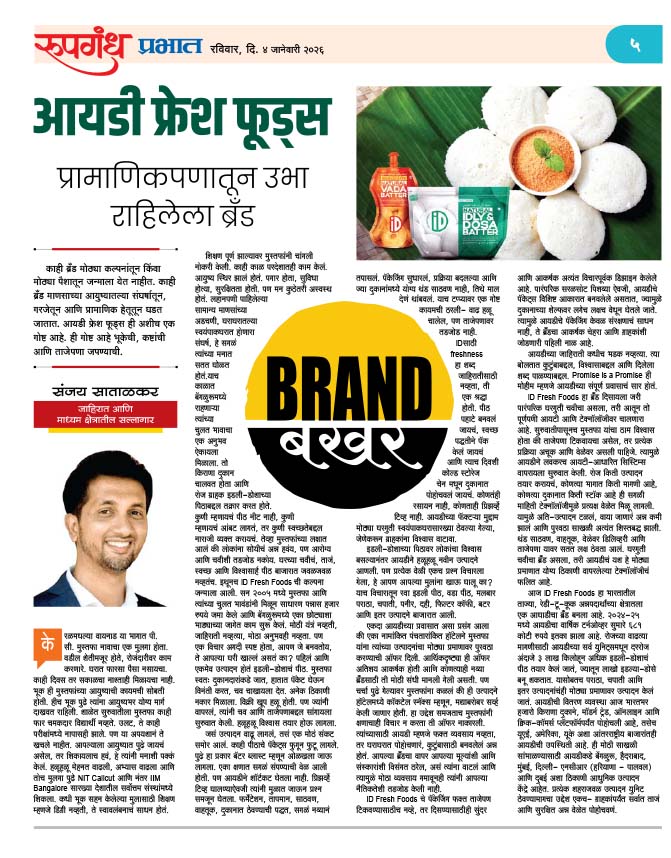
iD Fresh Foods: A Brand Built on Honesty
Some brands are not born out of big ideas or big money. Some brands grow out of struggle, necessity, and honest intent. iD Fresh Foods is one such story. It is a story of hunger, hard work, and a deep commitment to preserving “freshness.”
In the Wayanad region of Kerala, a boy named P. C. Musthafa was growing up. His father was a farm labourer, working on daily wages. There was very little money at home. Some days, even breakfast was not available. Hunger became a constant companion in Musthafa’s life. And it was this hunger that later guided him throughout his journey.
In school, Musthafa was not a very bright student in the beginning. In fact, he even failed some exams. But these failures did not break him. He made a firm decision in his mind: “If I want to move ahead in life, I must study.” Slowly, his hard work increased, his focus improved, and the same boy went on to study at NIT Calicut and later at IIM Bangalore, two of the country’s top institutions. For a boy who had experienced hunger, education was not just about a degree—it was a tool for self-reliance.
After completing his education, Musthafa took up a good job. He even worked abroad for some time. Life had become stable. There was a salary, comforts, and security. Yet, his mind remained restless. The struggles of ordinary people he had seen in childhood, and the daily challenges inside Indian kitchens, kept coming back to him again and again.
Around this time, he heard about an experience of his cousin who was living in Bengaluru. His cousin ran a grocery store, and customers complained daily about idli–dosa batter. Some said the batter was inconsistent, some said it tasted sour, and others complained about hygiene. That’s when Musthafa realised something important: people wanted convenient food, but not at the cost of health or taste. Fresh, clean, home-style, trustworthy batter was almost non-existent in the market.
This is where the idea of iD Fresh Foods was born. In 2005, Musthafa and his cousins pooled together around ₹50,000 and started work in a small rented space in Bengaluru. There were no big machines, no advertising, and no major experience. But there was one clear thought: Would we eat what we are making in our own home? Their first and only product was idli–dosa batter.
Musthafa personally visited shopkeepers, carrying packets in his hands, requesting them to try the product and taste it. He faced rejection at many places. Sales were very slow. But those who tried the batter began talking about its taste and freshness. Slowly, trust started building.
As the business began to grow, a major crisis appeared. Some batter packets started swelling and bursting. This problem later became known as the “batter blast.” In that moment, it felt like everything could collapse. But iD did not take shortcuts. Instead of adding preservatives, they went to the root of the problem. They studied fermentation, temperature, storage, transportation, and how the product was kept in shops. Packaging was improved, processes were changed, and supplies were stopped to stores that did not have proper cold storage. At this stage, one principle became permanent—growth could be slow, but freshness would never be compromised.
For iD, freshness was not a marketing word; it was a belief. Batter was made early in the morning, packed hygienically, and delivered to stores the same day through a cold storage chain. No chemicals. No preservatives. iD factories were deliberately designed to look like large home kitchens, so that customers could feel trust and comfort.
Once people trusted iD’s idli–dosa batter, the company slowly introduced new products. But every time, they asked the same question: Would we feed this to our own children? With this thought, products like rava idli batter, vada batter, Malabar parota, chapati, paneer, curd, filter coffee, butter, and many more were introduced.
During iD’s journey, there was an incident when a well-known five-star hotel offered Musthafa a large supply contract. Financially, it was a very attractive offer and would have been considered a big opportunity for any growing brand. But during discussions, Musthafa realised that the products would be served as cocktail snacks along with alcohol. The moment he understood this, he rejected the offer without hesitation. For him, iD was not just a business—it was food meant for families and homes. He felt this usage went against his values and upbringing. Even at the cost of losing a big business opportunity, he chose not to compromise on ethics.
iD Fresh Foods’ packaging is thoughtfully designed not only to preserve freshness but also to look attractive. Instead of ordinary straight pouches, iD packets come in distinctive shapes that immediately catch attention on store shelves. The packaging is not just protection—it is the face of the brand and the first connection with the customer.
iD’s advertisements were never loud or flashy. They spoke about family, trust, and keeping one’s word. The “Promise is a Promise” campaign captured the essence of iD’s entire journey.
Though iD Fresh Foods appears traditional and home-style from the outside, internally it is completely driven by IT and technology. From the beginning, Musthafa strongly believed that to maintain freshness, every process must be accurate and timely. iD adopted IT-based systems early on. Real-time data on how much to produce, regional demand, and store-level stock became available through technology. This helped avoid overproduction, reduced food wastage, and brought discipline to the supply chain. Cold storage, transportation, timely delivery, and freshness could be constantly monitored. Though the brand represents home-style food, iD’s success is largely due to the smart use of technology in the right places.
Today, iD Fresh Foods has become a leading brand in India’s fresh, ready-to-cook food segment. In FY 2024–25, iD achieved an annual turnover of around ₹681 crore. To meet growing demand, iD’s units together produce over 3 lakh kilograms of idli–dosa batter every day, enough to make millions of idlis and dosas. Along with this, parathas, chapatis, and other products are also produced at scale. iD’s distribution network now reaches thousands of grocery stores, modern trade outlets, online platforms, and quick-commerce channels across India. The brand is also present in international markets such as the UAE, the USA, and the UK. To manage this scale, iD has modern manufacturing units in Bengaluru, Hyderabad, Mumbai, Delhi-NCR (Haryana–Palwal), and Dubai. The purpose of having production units close to cities is simple—to deliver the freshest and safest food to customers on time. iD plans to further increase production capacity in the future. Discussions around an IPO exist, but Musthafa always says the next step will be taken only when the company is fully ready.
iD Fresh Foods is not just a food company. It is the story of a boy who once experienced hunger and today feeds millions with fresh, safe food. In a world full of shortcuts, iD teaches us a simple but powerful lesson—when intentions are honest, patience is strong, and humanity comes first, success finds its own way. That is why iD does not just sell food; it earns trust. Choosing values over big opportunities, preserving home-style taste while wisely using modern technology—this is the true identity of iD.
Writer: Sanjay Satalkar
Consultant in Advertising & Marketing