

NVIDIA
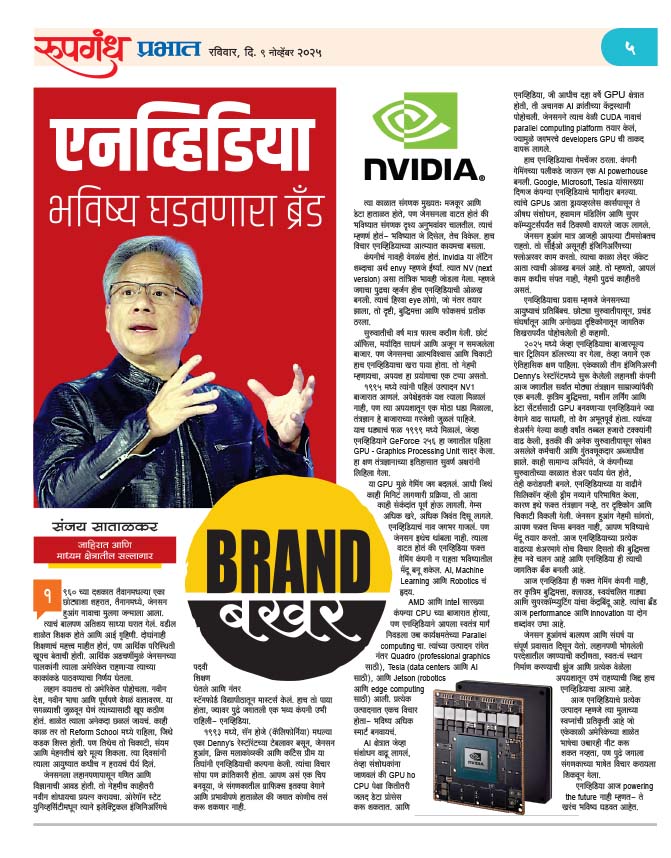
NVIDIA – The Brand Shaping the Future
In the 1960s, in a small town called Tainan in Taiwan, a boy named Jensen Huang was born. His
childhood was spent in very humble surroundings — his father was a schoolteacher and his mother a
homemaker. Both valued education deeply, but financial conditions were tough. Due to economic
hardship, Jensen’s parents decided to send him to live with his relatives in the United States.
At a young age, he arrived in America — a new country, a new language, and a completely different
culture. Adapting to all this was extremely difficult for him. He was often bullied in school and even
spent some time in a reform school — a place known for its discipline and strictness. But it was there
that Jensen learned the true meaning of perseverance, patience, and hard work. Those days gave
him the courage never to give up in life.
From childhood, Jensen was passionate about mathematics and science. He was always trying to create or discover something new. He earned his bachelor’s degree in Electrical Engineering from Oregon State University and later completed his Master’s from Stanford University. This became the foundation on which one of the world’s greatest companies — NVIDIA — was built.
In 1993, at a Denny’s restaurant table in San Jose, California, Jensen Huang, Chris Malachowsky, and Curtis Priem conceived the idea of NVIDIA. Their vision was simple but revolutionary:
“Let’s create a chip that can handle computer graphics faster and more efficiently than anyone else in the world.”
At that time, computers primarily dealt with text and data. But Jensen believed that the future of computing would be visual. He often said, “What you see will be what sells.” This vision became the soul of NVIDIA.
The company’s name too had a story. Derived from the Latin word “Invidia” meaning “envy”, it also incorporated the tech abbreviation “NV” for next version. In essence, NVIDIA stood for “the next version of the world.” Its iconic green “eye” logo that followed symbolized vision, intelligence, and focus.
The early years were extremely challenging — a small office, limited resources, and a market that didn’t yet understand their vision. But Jensen’s confidence and persistence became NVIDIA’s true foundation. He often said, “Failure is just one stage of experimentation.”
In 1995, NVIDIA launched its first product — the NV1. It didn’t succeed as expected, but it taught them an invaluable lesson: “Technology must align with market needs.” The payoff came in 1999, when NVIDIA introduced the GeForce 256, the world’s first GPU (Graphics Processing Unit) — a landmark moment in tech history.
This GPU transformed the world of gaming. Processes that once took minutes were now completed in seconds. Games looked more realistic and alive. NVIDIA became a global name. But Jensen didn’t stop there. He envisioned NVIDIA as more than a “gaming company” — he wanted it to become the brain of the future — powering AI, Machine Learning, and Robotics.
While companies like AMD and Intel dominated the CPU market, NVIDIA chose a unique path — high-performance parallel computing. Their product line expanded with Quadro (for professional graphics), Tesla (for data centers and AI), and Jetson (for robotics and edge computing). Every product shared one vision — “to make the future smarter.”
As research in AI accelerated, scientists discovered that GPUs could process data much faster than CPUs. Having already spent a decade perfecting GPU technology, NVIDIA found itself at the center of the AI revolution. Jensen then introduced CUDA, a parallel computing platform that allowed developers worldwide to harness the power of GPUs.
This became NVIDIA’s game changer. The company evolved from a gaming brand to an AI powerhouse. Giants like Google, Microsoft, and Tesla became partners. NVIDIA’s GPUs now power everything — from driverless cars and drug discovery to climate modeling and supercomputers.
Despite his success, Jensen Huang remains deeply involved with his team. Even as CEO, he still works on the engineering floor. His trademark black leather jacket has become symbolic of his personality. He says, “Our work never ends; there’s always something next.”
NVIDIA’s journey mirrors Jensen’s own life — rising from humble beginnings, enduring immense struggle, and achieving greatness through a distinct vision.
In 2025, when NVIDIA’s market value surpassed $4 trillion, the world witnessed history. A company once founded by three engineers in a Denny’s restaurant had become one of the most powerful technology empires ever. NVIDIA’s exponential growth in AI, machine learning, and data center GPUs was unmatched. Its stock skyrocketed by thousands of percent, turning many early employees and investors into billionaires. Even ordinary engineers who received stock options in the early days became millionaires.
NVIDIA redefined the “Silicon Valley Dream.” It wasn’t just about technology — it was about vision and perseverance. As Jensen Huang famously said, “We don’t just build chips — we build the brain of the future.”
Today, behind every rising NVIDIA share lies the belief that intelligence is the new currency, and NVIDIA is its global bank.
NVIDIA is no longer just a gaming company — it is the epicenter of Artificial Intelligence, Cloud Computing, Autonomous Vehicles, and Supercomputing. Its brand now stands firmly on two words — Performance and Innovation.
Jensen Huang’s childhood struggles and relentless spirit are reflected throughout NVIDIA’s journey. His early hardships, his fight to create an identity in a foreign land, and his ability to rise stronger after every failure — that is the soul of NVIDIA.
Every NVIDIA product today is a reflection of that little boy’s dream — the boy who once struggled to pronounce English words in an American school but went on to teach the world the new language of computing.
Today, NVIDIA doesn’t just say “powering the future” — it is truly creating the future.
Written by: Sanjay Satalkar
Consultant – Advertising and Marketing